
Understanding Idemitsu specifications starts with distinguishing the lubricant’s product name from the standards and vehicle requirements it meets. Idemitsu is a lubricant manufacturer; its automotive range uses industry classifications and application-specific references to describe product suitability.
An Idemitsu engine oil may carry an SAE viscosity grade and API or ILSAC performance classification. A transmission fluid may instead identify applications requiring Toyota WS, Nissan NS-3 or Honda HCF-2.
For workshops and lubricant distributors, these references answer different questions. Reading them correctly helps prevent a product designation from being mistaken for a universal specification or approval.
The term can refer to several types of information on a label or technical data sheet:
Information | Example | What it identifies |
Product name | Idemitsu IFG 3 | The manufacturer’s product range |
Viscosity grade | SAE 0W-20 | Engine-oil viscosity classification |
Industry performance category | API SQ or ILSAC GF-7A | Defined engine-oil performance requirements |
Transmission-fluid product designation | Idemitsu ATF Type TLS-LV | A particular product within the transmission-fluid range |
Vehicle-manufacturer fluid reference | Toyota WS | The application requirement addressed by the product claim |
These descriptions should be read together. A brand name alone does not establish suitability, and a product code is not automatically an industry-wide standard.
For example, Idemitsu’s American product library lists IFG 3 0W-20 SQ/GF-7A alongside separately designated ATF and CVT fluids. The naming reflects distinct product types and requirements. Idemitsu’s product library shows these classifications.
When selecting an Idemitsu engine oil, separate viscosity from performance.
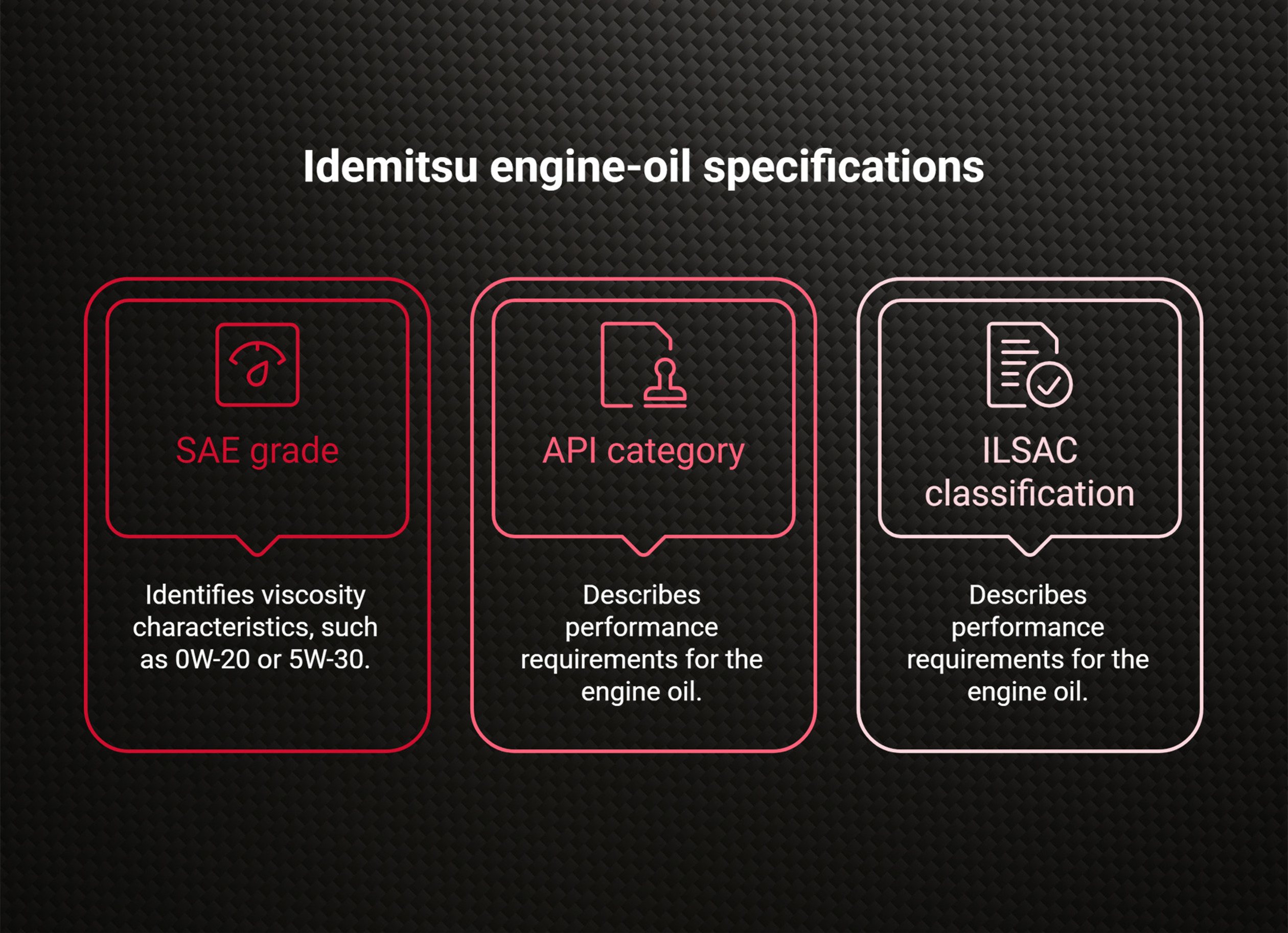
The SAE grade, such as 0W-20 or 5W-30, identifies viscosity characteristics. The API category and ILSAC classification describe performance requirements. The vehicle manufacturer determines which combination is appropriate for the engine.
As an example, the designation IFG 3 0W-20 SQ/GF-7A contains three separate elements:
IFG 3: the product range.
0W-20: the SAE viscosity grade.
SQ/GF-7A: the stated API and ILSAC performance classifications.
This is an example of how to interpret a name, rather than a recommendation for every vehicle requiring 0W-20. Check the exact engine requirements and the product documentation applicable to the market concerned. Idemitsu publishes this product under its full viscosity and performance designation.
API operates the Engine Oil Licensing and Certification System, which authorizes qualifying marketers to display its engine-oil quality marks. The programme includes monitoring of licensed oils and checks on how those marks are used.
A product’s stated performance category and its licensing status are related but distinct pieces of information. Where API licensing is required, verify the exact product through API’s licensing resources rather than assuming that every oil from a particular manufacturer has the same status. API explains its licensing and monitoring system.
Automatic transmission fluid, or ATF, must suit the requirements of the particular transmission. Idemitsu uses product designations to distinguish fluids intended for different applications.
Two examples illustrate why the complete name matters:
Idemitsu product | Application reference stated by Idemitsu |
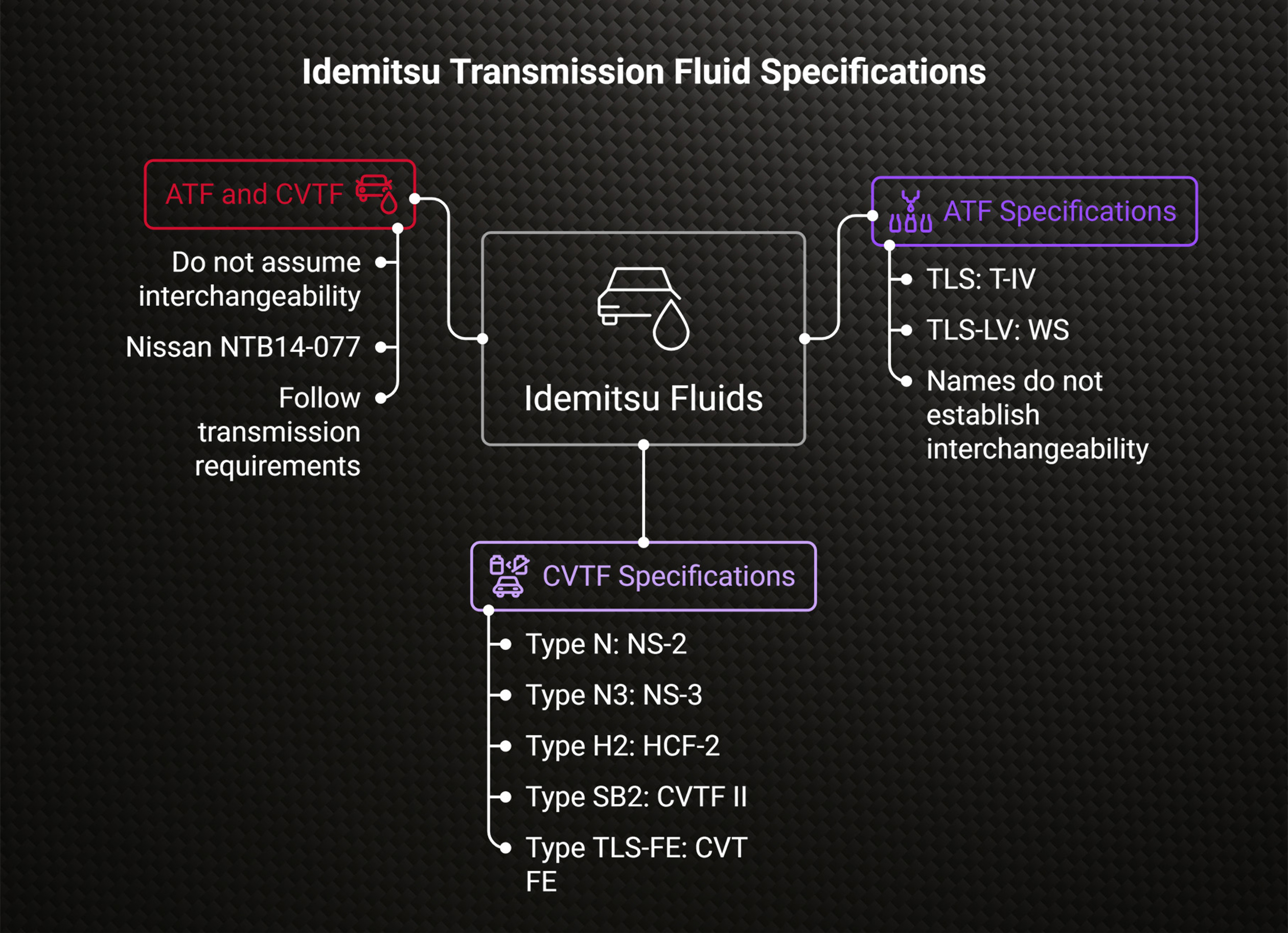
ATF Type TLS | Toyota, Lexus and Scion automatic transmissions requiring T-IV |
ATF Type TLS-LV | Toyota, Lexus and Scion automatic transmissions requiring WS |
Idemitsu describes these products as meeting the respective application requirements. These are claims made by the manufacturer and should not be presented as official Toyota approvals unless supported by the appropriate documentation. See the official pages for ATF Type TLS and ATF Type TLS-LV.
The similarity between the names does not establish interchangeability. A workshop should first identify whether the transmission requires T-IV, WS or another fluid, then evaluate the matching product.
Continuously variable transmission fluid, or CVTF, has its own application requirements. Idemitsu’s American CVTF range includes the following references:
Idemitsu product | Application requirement identified by Idemitsu |
CVTF Type N | Nissan/Infiniti NS-2 |
CVTF Type N3 | Nissan/Infiniti NS-3 |
CVTF Type H2 | Honda HCF-2 |
CVTF Type SB2 | Subaru CVTF II |
CVTF Type TLS-FE | Toyota/Lexus/Scion CVT FE |
These mappings explain the manufacturer’s stated applications. They are not a universal substitution chart, and the vehicle’s exact transmission requirements remain decisive. Idemitsu’s CVTF overview provides the application references.
A higher number in a product name should not be interpreted as automatic backward compatibility. For example, the name “Type N3” alone does not establish that it can replace Type N in an NS-2 application.
Do not assume that products are interchangeable because both lubricate transmissions.
Vehicle-manufacturer instructions can distinguish these fluids explicitly. Nissan’s service bulletin NTB14-077, covering specified NS-3 CVT applications, warns against using conventional ATF or manual-transmission fluid in those CVTs and instructs against mixing with other fluids.
The bulletin applies to its listed vehicles, but it demonstrates why fluid selection must follow the transmission requirement rather than a broad description such as “automatic gearbox oil.” Nissan’s NS-3 service bulletin states the relevant restrictions.
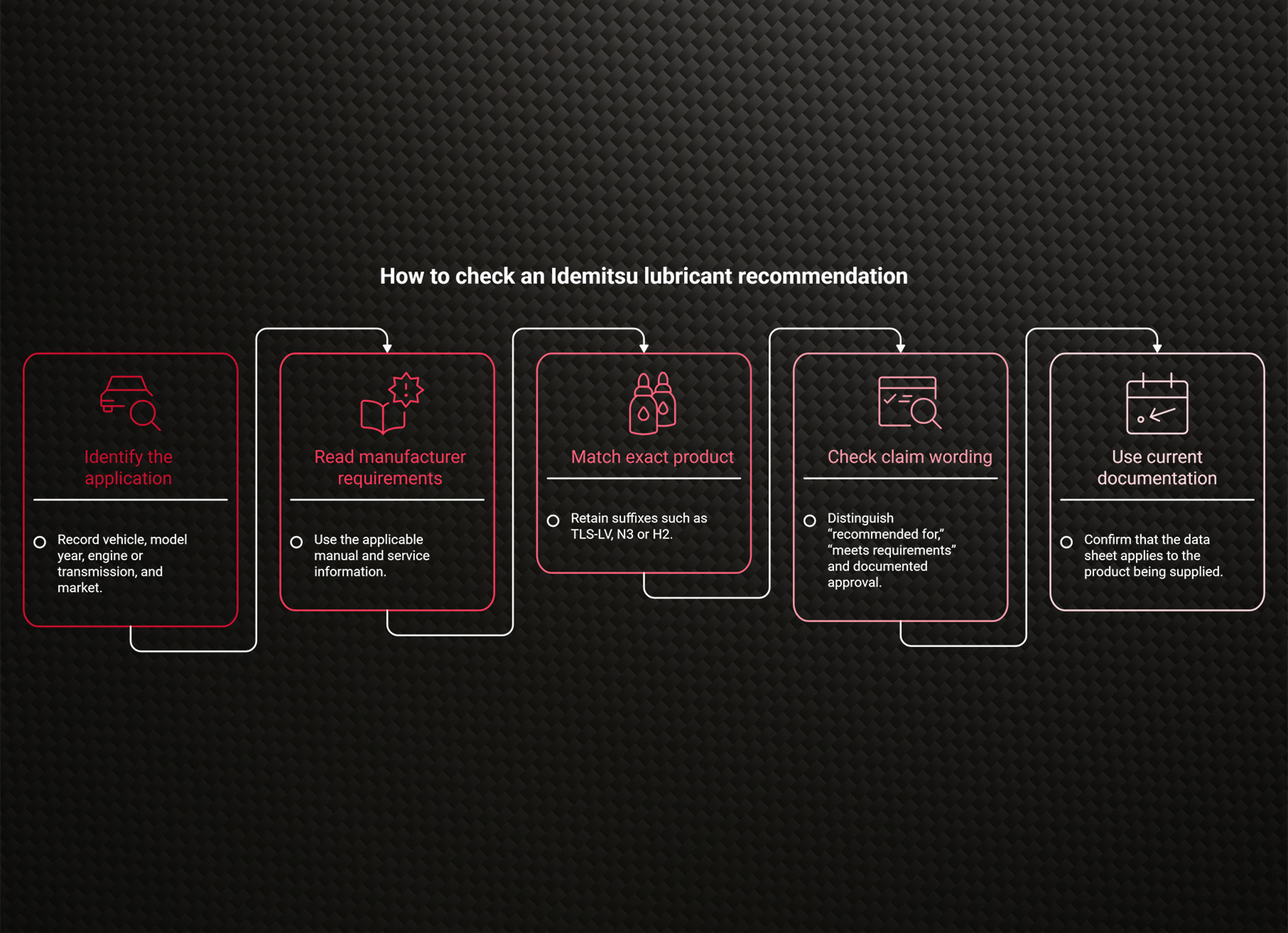
For a reliable product recommendation, record the complete requirement before comparing brands:
Identify the application: vehicle, model year, engine or transmission, and market.
Read the manufacturer’s requirement: use the applicable manual and service information.
Match the exact product: retain suffixes such as TLS-LV, N3 or H2.
Check the claim wording: distinguish “recommended for,” “meets requirements” and documented approval.
Use current documentation: confirm that the data sheet applies to the product being supplied.
When comparing an alternative lubricant with an Idemitsu product, use the underlying engine or transmission requirement as the starting point. A reference to the Idemitsu brand alone is insufficient to establish equivalence.
Clear documentation connects the product name, viscosity or fluid type, performance claims and vehicle requirements. That connection is what makes an Idemitsu specification useful for accurate purchasing and servicing.