




SAE oil viscosity grades such as 0W-20, 5W-30 and 10W-40 are among the most visible details on an engine-oil label. They describe rheological limits, not overall lubricant quality or vehicle compatibility. Understanding both sides of a multigrade helps workshops and buyers explain cold-start performance, operating-temperature viscosity and why two oils with the same grade may still be technically different.
What does viscosity mean?
Viscosity is a fluid’s resistance to flow. Engine oil becomes more viscous as temperature falls and less viscous as temperature rises. The lubricant must therefore remain pumpable during a cold start while maintaining adequate film behaviour in the hot, loaded engine.
SAE J300 classifies engine oils in rheological terms. It does not define detergent performance, wear protection, deposit control, aftertreatment compatibility or OEM approval. Those properties are addressed through API, ACEA, ILSAC and manufacturer specifications.
What does the W in 5W-30 mean?
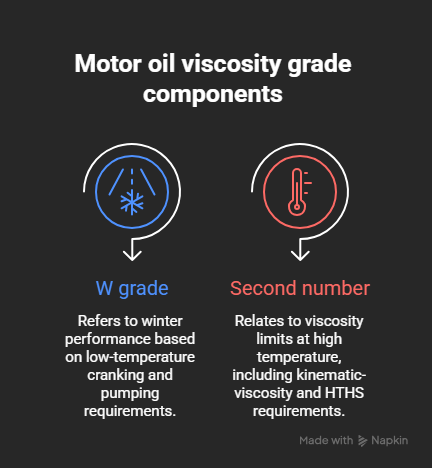
The W refers to winter performance, not oil “weight”. The first part of a multigrade—such as 0W, 5W or 10W—is assigned using defined low-temperature cranking and pumping requirements. A lower W grade is tested at lower temperatures and can support faster circulation and easier cranking in cold conditions when the engine is designed for it.
This does not mean that 0W oil is always better. The manufacturer selects the grade around bearing clearances, oil-pump design, climate, fuel-economy targets, durability and other engineering factors.
What does the second number mean?
The second number—20, 30, 40 and so on—relates to viscosity limits at high temperature. It includes kinematic-viscosity limits at 100 °C and minimum high-temperature high-shear viscosity requirements for the grade.
HTHS viscosity represents oil behaviour under high temperature and high shear, closer to heavily loaded engine zones. Different performance specifications can require different HTHS levels even when the visible SAE grade looks similar.
Why multigrade oils are used
A multigrade oil is formulated to satisfy both a winter grade and a high-temperature grade. Compared with an appropriate monograde, it can provide a wider useful temperature range, improved cold-start circulation and stable viscosity behaviour during operation.
Base-oil selection and viscosity-modifying polymers can both contribute to multigrade performance. Formulators must balance low-temperature flow, volatility, shear stability, oxidation resistance and deposit control.
Is thicker oil always more protective?
No. An oil that is too viscous can circulate slowly during start-up, increase pumping losses, reduce hydraulic response and interfere with systems designed around low-viscosity oil. An oil that is too thin for the application may not maintain the required film under load and temperature.
Protection comes from the correct viscosity combined with the complete formulation and specification. Moving from 5W-30 to 10W-40 to address oil consumption or noise without technical approval can mask a mechanical issue and create new lubrication risks.
Why two 5W-30 oils can be completely different
SAE grade confirms viscosity classification only. One 5W-30 may be a low-SAPS ACEA C3 oil for a diesel particulate filter; another may satisfy a fuel-economy category with lower HTHS viscosity; another may be designed for a specific North American or Asian OEM requirement.
The correct comparison therefore includes SAE grade, API or ACEA category, OEM approval, SAPS profile and application. Never substitute solely because the viscosity numbers match.
Practical viscosity selection checklist
- Use the viscosity grades listed in the vehicle or equipment manual.
- Consider the manufacturer’s ambient-temperature chart where provided.
- Match the complete API, ACEA and OEM specification.
- Do not increase viscosity automatically for high mileage.
- Investigate abnormal consumption, pressure or noise mechanically.
- Check whether extended drains or severe service change the recommendation.
- Confirm the final choice in the current lubricant selector and TDS.
Conclusion
SAE oil viscosity grades describe how engine oil meets defined low- and high-temperature rheological limits. The W grade supports cold-start selection; the second number describes hot-viscosity limits. Neither part proves overall quality or compatibility. The correct engine oil is always the grade and specification approved for the exact engine and operating conditions.
Follow all our latest news and photos on our Facebook / Instagram page Ardeca Official