




ACEA oil specifications are widely used for European passenger cars, light commercial vehicles and heavy-duty diesel engines. They describe minimum performance levels for engine oils, but they are often reduced to a single code on a label. This guide explains how the ACEA Oil Sequences are structured, what the letters and numbers mean and how professionals should use them without treating one category as universally “better” than another.
What are the ACEA Oil Sequences?
The ACEA Oil Sequences are industry performance requirements published by the European Automobile Manufacturers’ Association. They combine laboratory, engine and bench tests that address areas such as wear, deposits, oxidation, sludge, piston cleanliness, aftertreatment compatibility and, in selected categories, fuel economy.
ACEA periodically revises the sequences as engine technology, emissions legislation and test availability evolve. A category should therefore be read together with its issue year when that information is relevant. Product claims must be supported according to the applicable ACEA rules; the category name is not simply a marketing description.
The three main ACEA families
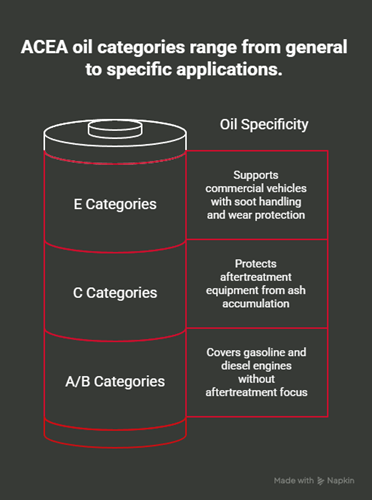
Light-duty categories are broadly divided into A/B and C families. A/B categories cover gasoline and light-duty diesel engines without the specific aftertreatment-focused limits that define the C family. C categories are catalyst-compatible oils for gasoline and light-duty diesel vehicles equipped with aftertreatment systems, subject to category-specific SAPS and viscosity requirements.
ACEA E categories apply to heavy-duty diesel engines. These categories consider the demands of commercial vehicles, including soot handling, piston deposits, wear, oxidation and compatibility with exhaust aftertreatment. The correct E category depends on the engine generation, emissions system, fuel and OEM requirement.
What do A/B categories mean?
An A/B code does not represent viscosity. For example, ACEA A3/B4 can be found in several SAE grades. The category describes a defined performance profile. Some A/B categories are intended for high-performance or extended-drain applications, while others were developed around fuel-economy and lower-viscosity operation.
Never upgrade or substitute an A/B category by intuition. An oil with a newer-looking or numerically higher code is not automatically suitable for an engine that requires another category. Follow the exact vehicle-manufacturer recommendation.
What do ACEA C categories mean?
ACEA C oils are designed for vehicles with systems such as diesel particulate filters and three-way catalysts. Their chemical limits help protect aftertreatment equipment from ash accumulation or catalyst poisoning. This is where SAPS becomes important: sulphated ash, phosphorus and sulphur are linked to additive chemistry and can affect emissions-system durability.
Low-SAPS and mid-SAPS are useful market terms, but the actual ACEA category matters. C2, C3, C5, C6 and C7 do not merely represent increasing quality. They differ in high-temperature high-shear viscosity, fuel-economy intent, test requirements and permitted applications. A C3 oil should not replace a C2, C5 or C6 oil unless the OEM explicitly allows it.
ACEA E categories for heavy-duty engines
Heavy-duty categories must be matched to engine design and emissions architecture. Some categories support engines with particulate filters and other aftertreatment devices, while others serve different generations or operating profiles. Fleet operators should also check the exact OEM approval, because truck manufacturers often add proprietary tests and drain-interval requirements beyond the general ACEA category.
For mixed fleets, one lubricant may cover several engines only when every mandatory ACEA and OEM requirement is listed on the current technical data sheet.
ACEA category versus OEM approval
ACEA defines an industry baseline; an OEM specification can add manufacturer-specific tests, limits and field requirements. A lubricant may claim an ACEA category without holding every OEM approval associated with oils in that market segment.
When the handbook specifies an OEM approval, that approval is the primary requirement. Check whether the product is formally approved, meets the specification, or is merely recommended by the lubricant supplier. These statements should not be treated as identical.
Professional ACEA selection checklist
- Identify the exact engine, model year and emissions system.
- Confirm the SAE viscosity permitted by the manufacturer.
- Record the complete ACEA category, including the relevant issue where required.
- Check the exact OEM specification or approval.
- Confirm that the claim appears on the latest product data sheet.
- Do not mix categories based only on SAPS level or viscosity.
- Use an up-to-date oil selector and verify the result against vehicle documentation.
Conclusion
ACEA oil specifications are a technical selection tool, not a ranking system. A/B, C and E categories serve different engines and operating requirements, while SAPS, HTHS viscosity and aftertreatment compatibility vary by category. The safest professional approach is to match the exact ACEA category, SAE grade and OEM requirement specified for the vehicle.
Follow all our latest news and photos on our Facebook / Instagram page Ardeca Official