
Parker Denison specifications help identify hydraulic fluids suitable for specific equipment requirements. References such as HF-0, HF-1 and HF-2 frequently appear on hydraulic-oil technical data sheets, alongside viscosity grades and industry standards.
For distributors, workshops and maintenance teams, understanding these references helps prevent selection errors. A Parker Denison specification, an ISO viscosity grade and a manufacturer’s approval each communicate different information. Selecting the correct hydraulic oil requires checking all three against the machine’s requirements.
Parker Denison specifications are equipment-manufacturer requirements used to evaluate hydraulic fluids. Parker publishes individual HF standards, evaluation procedures and a fluid ratings list through its Hydraulic Fluid Evaluation Process portal.
These references concern hydraulic applications. They should not be interpreted as engine-oil categories or as universal approvals covering every Parker component.
The full designation matters. A technical data sheet stating only “Denison” provides insufficient detail to establish which requirements the product claims to satisfy.
Parker’s instructions for its T7, T67 and T6 vane pumps describe the principal petroleum-based fluid categories as follows:
Specification | Fluid description in Parker’s instructions |
HF-0 | Petroleum-based anti-wear fluid |
HF-1 | Petroleum-based fluid without anti-wear additives |
HF-2 | Petroleum-based anti-wear fluid |
The same instructions identify petroleum-based fluids with anti-wear, rust-inhibiting and oxidation-inhibiting properties, covered by HF-0 and HF-2, as recommended fluids for the equipment discussed. See Parker’s vane-pump operating instructions.
These descriptions explain the broad fluid families; they do not reproduce the complete qualification requirements. HF-0 and HF-2 remain separate specifications, even though both are described as anti-wear petroleum-based fluids. Their detailed requirements must be checked in the applicable Parker specification documents.
The numbers should not be read as a simple progression in quality. An HF-2 designation does not mean that the fluid is automatically a higher-performance replacement for HF-0.
A product may carry multiple Parker Denison ratings. The broad description of a category does not mean that every product evaluated against it must carry only that designation.
For example, a Parker-issued approval letter dated January 2021 lists HF-0, HF-1 and HF-2 together for one hydraulic-oil product. The letter also identifies the approved viscosity grades and tested formulation technology.
This illustrates why the complete approval documentation matters. A combined claim can be legitimate, but it must be supported for the particular product and grades concerned. A historical letter does not, by itself, establish a product’s present approval status.
Parker’s evaluation portal also provides documents for HF-3, HF-4, HF-5, HF-6 and HF-8.
Its vane-pump instructions describe HF-3 as water-in-oil invert emulsions, HF-4 as water-glycol solutions and HF-5 as synthetic fluids. These categories address different fluid technologies; they are not interchangeable steps on a performance ladder.
Changing fluid type can affect the permitted operating conditions. Parker’s M5 vane-motor catalogue, for example, specifies reduced operating ratings for certain alternative fluids. Compatibility must therefore be checked for the exact component and application.
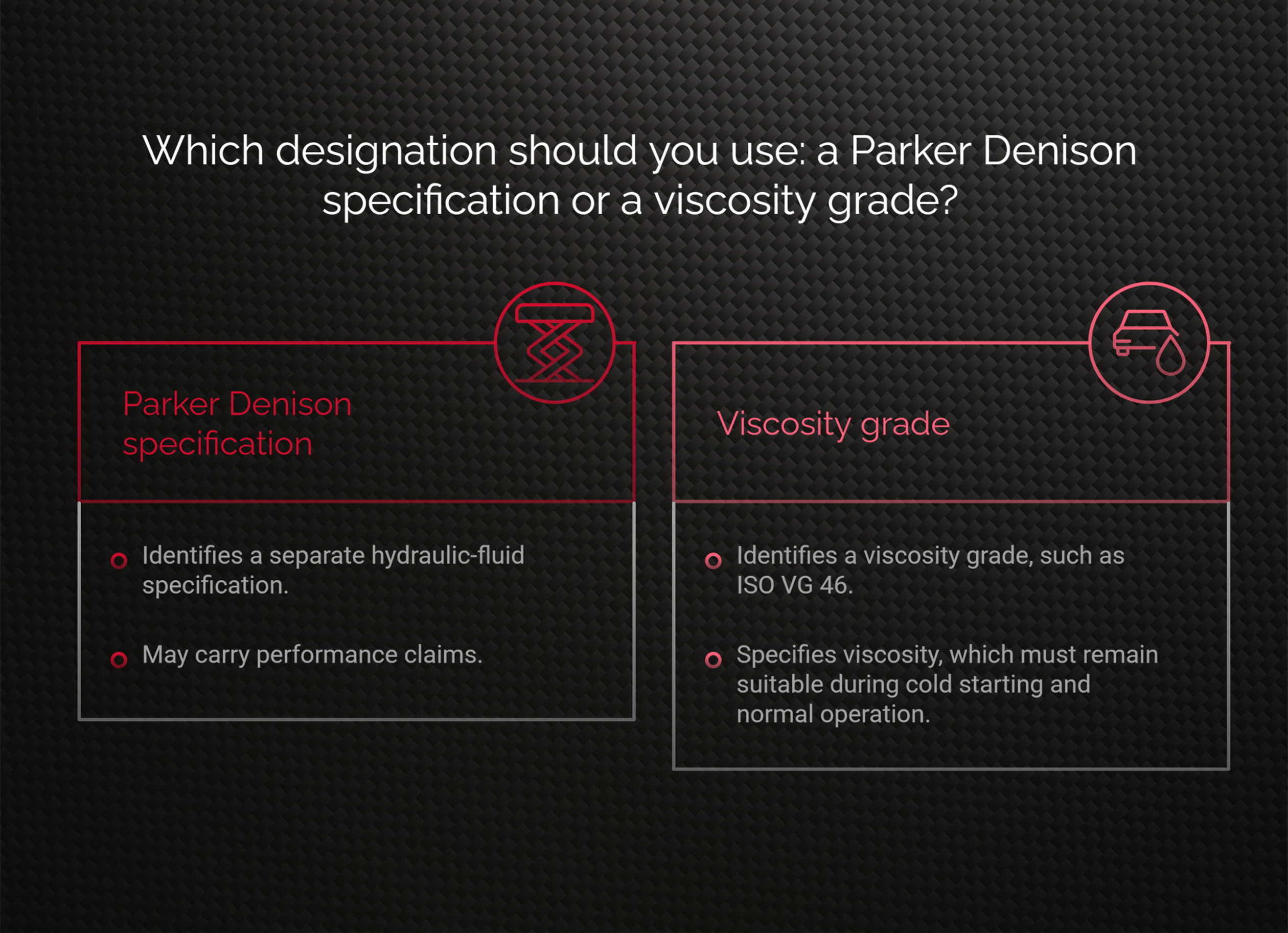
A designation such as ISO VG 46 identifies a viscosity grade. An HF-0 reference identifies a separate hydraulic-fluid specification.
Neither replaces the other:
Two oils with the same viscosity grade may carry different performance claims.
Two oils carrying the same Parker Denison rating may have different viscosities.
The required performance rating does not make an unsuitable viscosity acceptable.
Parker’s equipment documentation separately specifies fluid type, operating viscosity, temperature and seal requirements. This separation matters because the oil must remain suitable during both cold starting and normal operation.
For example, if a machine requires an ISO VG 46 oil with a particular Parker Denison rating, selecting an ISO VG 68 oil solely because it carries that rating leaves the viscosity requirement unresolved.
When comparing hydraulic oils, read the wording surrounding the specification carefully.
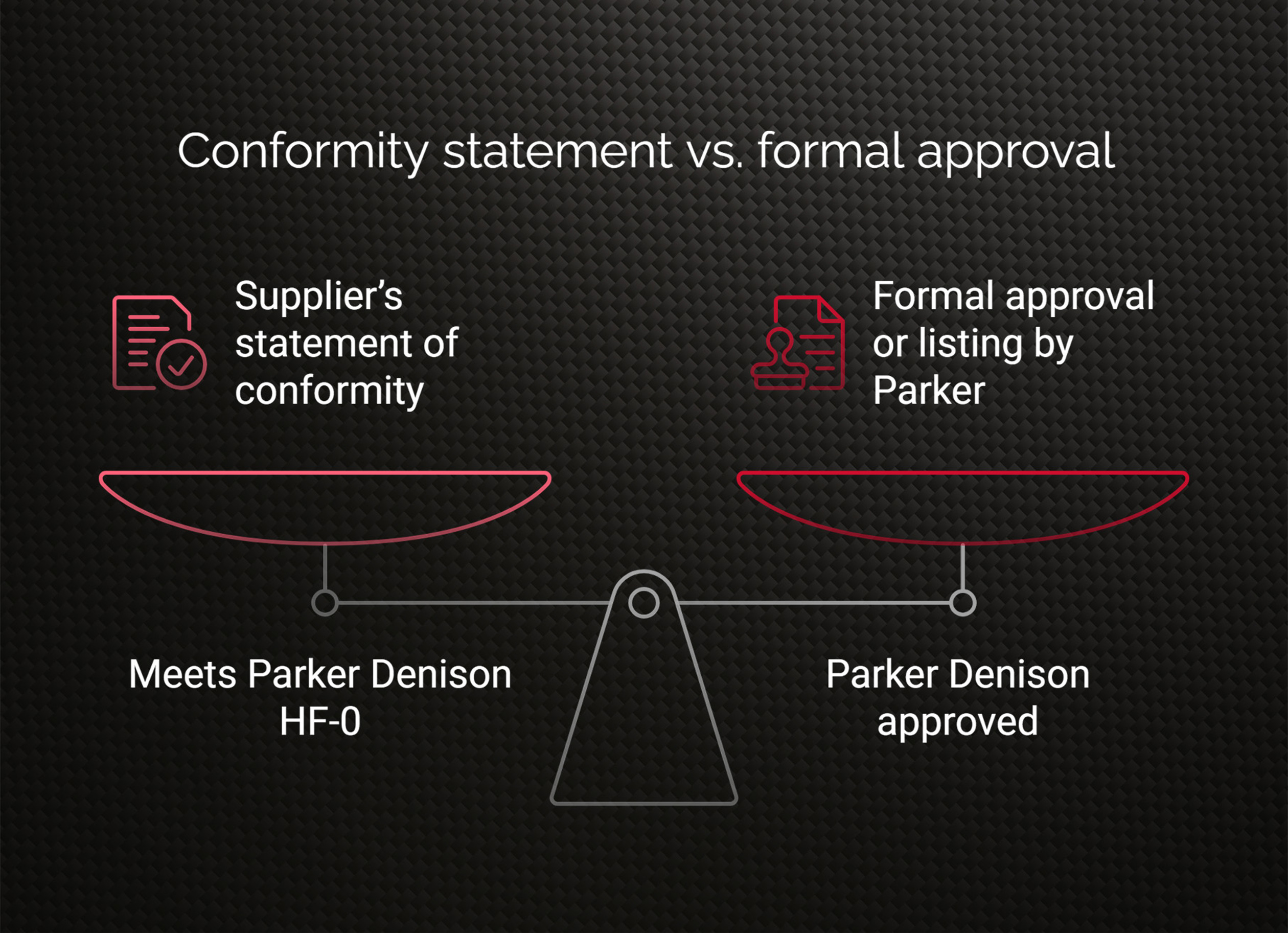
“Meets Parker Denison HF-0” is a supplier’s statement of conformity. It should not automatically be presented as evidence that Parker has formally approved or listed the product.
“Parker Denison approved” should be supported by documentation identifying the product and the scope of the approval. Parker’s fluid ratings list and relevant approval records are the appropriate starting points for verification.
For purchasing and technical records, check the exact product name, viscosity grade, HF designation and supporting documentation. Avoid extending an approval for one grade to every product sold under a similar name.
Begin with the machine manual and the documentation for its hydraulic components. Establish:
The required fluid specification: record the complete HF designation and any additional requirements.
The viscosity requirements: consider the specified grade and operating conditions.
The product’s documented status: distinguish supplier performance claims from formal approval.
The application limits: check permitted fluid types, seals, temperature, pressure and speed.
The maintenance requirements: follow the equipment instructions for filtration, contamination control and servicing.
Parker Denison specifications provide useful evidence when selecting hydraulic fluids, but they form only part of the decision. The correct choice combines the required performance specification with suitable viscosity, documented product status and the operating requirements of the complete hydraulic system.