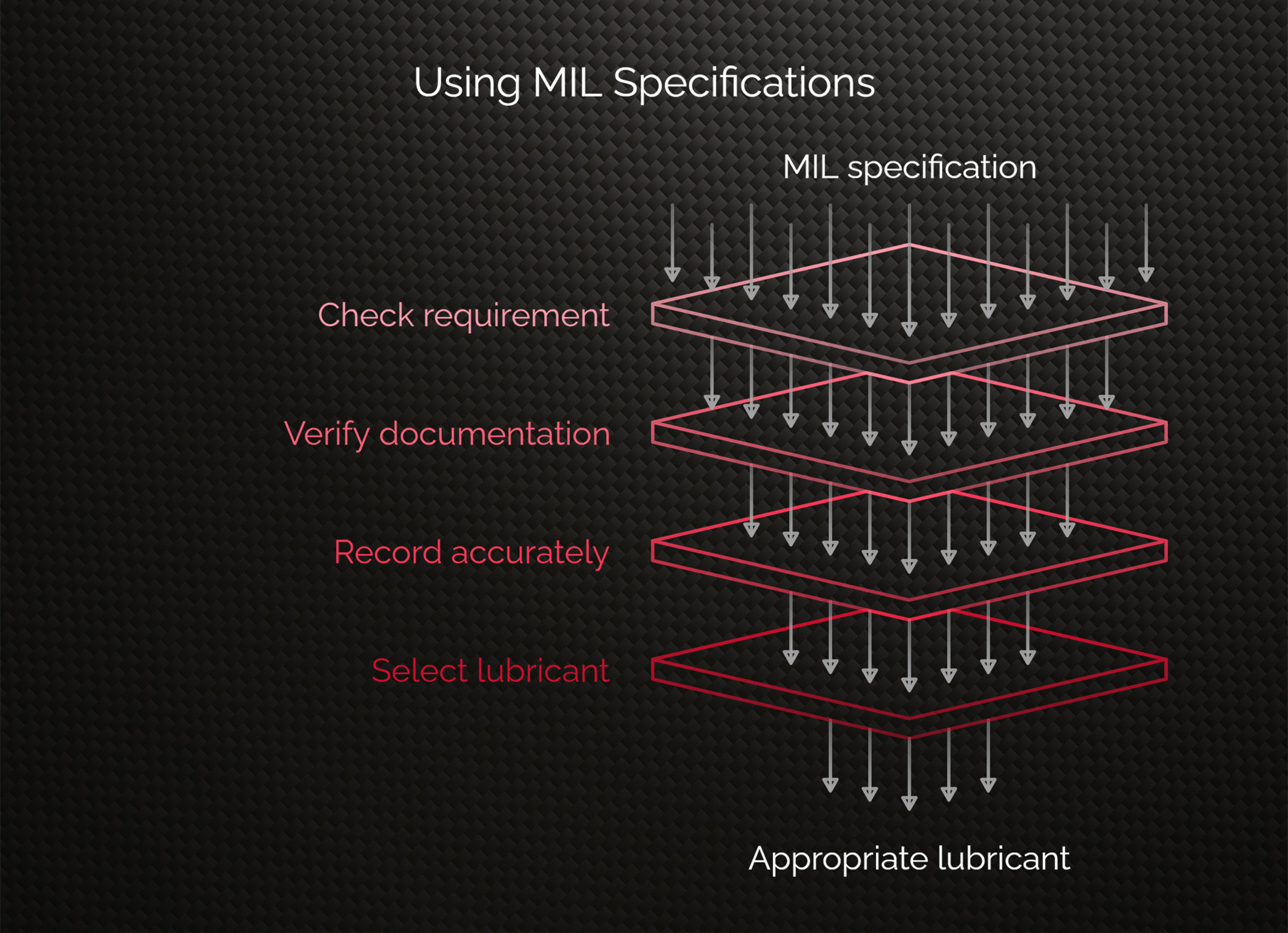

MIL specifications appear on technical data sheets for engine oils, gear oils, hydraulic fluids and greases. References such as MIL-PRF-2104 or MIL-PRF-23699 identify requirements developed for particular military applications.
For lubricant distributors and automotive professionals, their value lies in the detail behind the designation. A MIL reference must be interpreted together with its revision, product classification and any qualification requirements. The word “military” alone does not establish suitability for a machine.
MIL specifications are United States defence specifications describing technical requirements for products and materials. In lubrication, they address defined applications rather than forming one universal performance ranking.
Two main document types are:
MIL-PRF: a performance specification, describing required results and how compliance is verified.
MIL-DTL: a detail specification, which can prescribe design, material or construction requirements.
Older documents may retain prefixes such as MIL-L or MIL-G. The prefix format alone does not establish whether a document remains active. The Defense Standardization Program’s document guidance explains these naming conventions.
A larger specification number does not indicate higher lubricant quality. Different numbers generally identify different requirements and applications.
Consider MIL-PRF-2104N:
Element | Meaning |
MIL | Military specification designation |
PRF | Performance specification |
2104 | Specification number |
N | Revision identifier |
As of October 2026, the official ASSIST record lists MIL-PRF-2104 as active, with Revision N dated 1 April 2021. Its scope covers oils for compression-ignition engines and specified power-transmission applications in combat and tactical equipment. The ASSIST document record provides its status and revision history.
The full requirement may also include a viscosity grade, type or class. Recording only “MIL-PRF-2104” can therefore leave important selection information missing.
MIL references cover substantially different products.
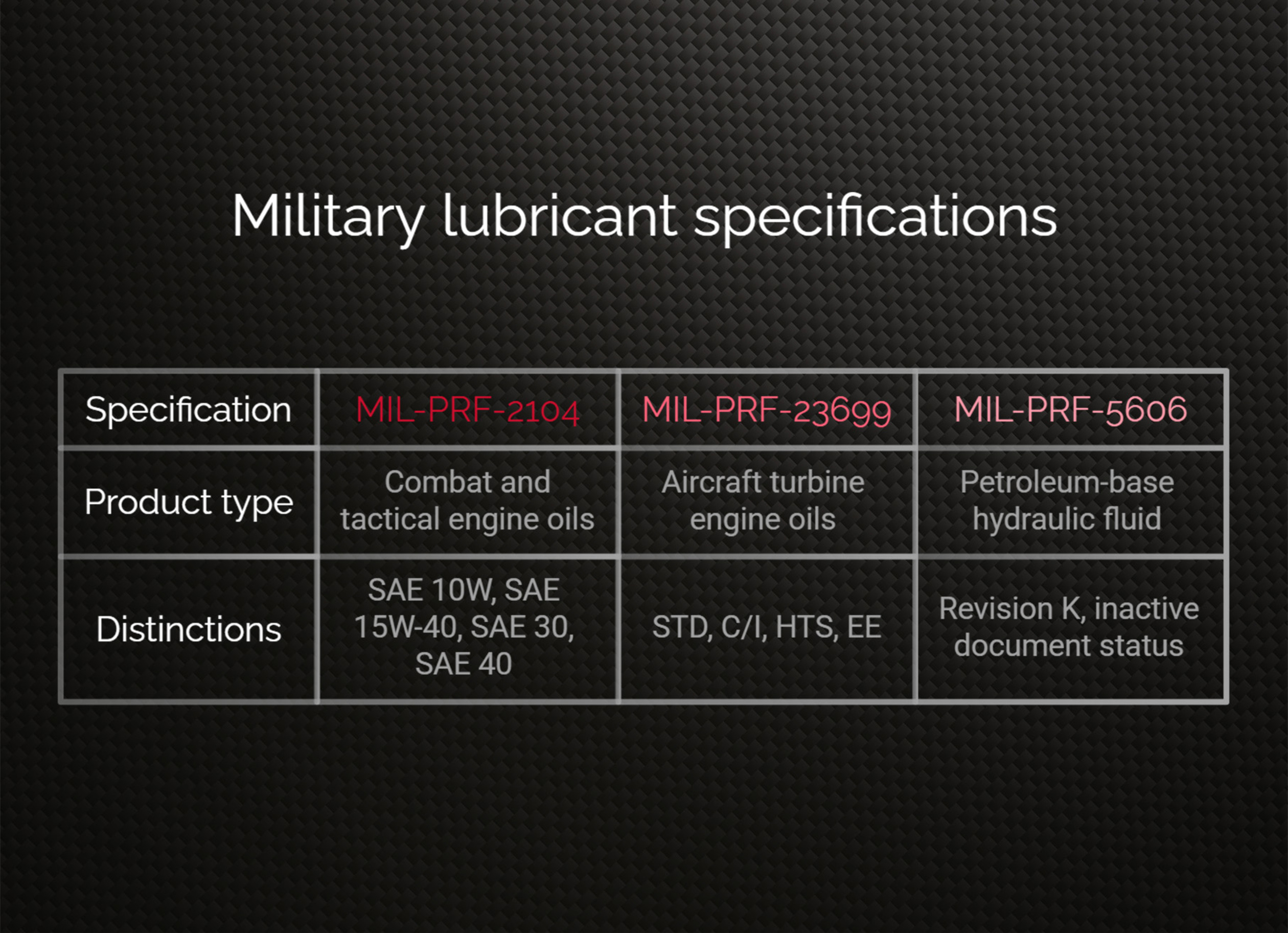
MIL-PRF-2104: combat and tactical engine oils
This specification illustrates why viscosity and performance must be checked separately. Its qualification database distinguishes SAE 10W, SAE 15W-40, SAE 30 and SAE 40 products.
An oil meeting one grade does not automatically satisfy an order for another. The required viscosity must be included when comparing products or preparing purchasing documentation. QPL-2104 shows these separate designations.
MIL-PRF-23699: aircraft turbine engine oils
MIL-PRF-23699 covers synthetic-base aircraft turbine engine lubricants. Its qualification database separates products into classes including STD, C/I, HTS and EE.
The specification number alone consequently does not identify the complete product requirement. The applicable class and equipment instructions also matter. QPL-23699 records these distinctions.
MIL-PRF-5606: petroleum-base hydraulic fluid
MIL-PRF-5606 addresses hydraulic fluid for aircraft, missile and ordnance applications. The official qualification database lists Revision K and an inactive document status while retaining qualification information.
This demonstrates why document status and product qualification must be examined separately. An inactive status should not be interpreted, by itself, as an instruction to replace fluid in existing equipment. QPL-5606 provides the relevant record.
Equipment manuals and lubricant catalogues can retain specifications long after those documents have been revised or replaced.
A useful example is MIL-PRF-2105, the former multipurpose gear-oil specification. ASSIST identifies it as cancelled and superseded by SAE J2360. An older MIL-PRF-2105E claim should therefore be recognised as a historical reference, rather than presented as the current governing specification. The official cancellation record identifies the successor.
SAE J2360 now addresses automotive gear lubricants for commercial and military use. Its December 2025 edition covers performance beyond API GL-5 and includes a qualification framework. A historical MIL-PRF-2105 claim or an API GL-5 claim alone does not establish current J2360 qualification. SAE’s published scope explains the requirements.
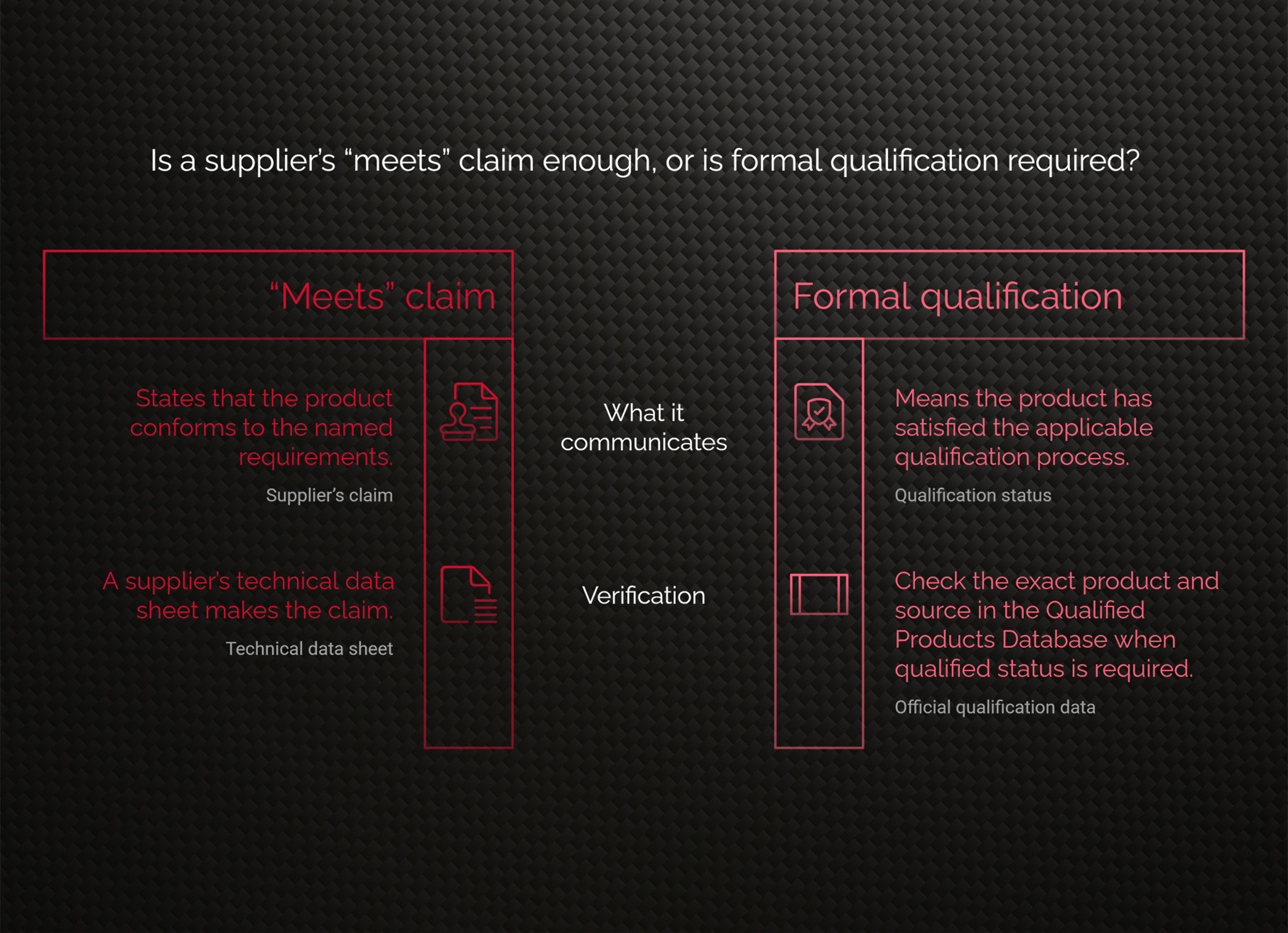
These statements communicate different things.
A supplier’s “meets” claim states that the product conforms to the named requirements. Formal qualification means the product has satisfied the applicable qualification process.
Where qualification is required, check the exact product and source in the Qualified Products Database, or QPD. A Qualified Products List, or QPL, identifies products qualified under its governing specification.
The Defense Standardization Program identifies the QPD as the official source for Department of Defense qualification data. A supplier’s technical data sheet should not replace that check when qualified status is required. The official qualification guidance explains how to access the records.
Qualification is also distinct from suitability for every machine. The equipment’s maintenance requirements remain part of the selection decision.
A MIL claim demonstrates relevance to a defined requirement; it does not create a universal comparison with commercial products.
For example, an aircraft turbine-oil specification and a combat-vehicle engine-oil specification address different applications. Their numbers cannot be used to rank one oil above the other.
Likewise, matching viscosity does not prove equivalent performance. The comparison must address the exact specification, revision, grade or class, and equipment requirements.
A clear purchasing record should identify:
The complete specification and required revision.
The viscosity grade, type or class.
The exact product and manufacturer.
Qualification evidence, where required.
Any additional equipment or contractual requirements.
When an older reference appears, check its official status and any successor document before recommending a replacement. Record historical claims accurately and avoid converting “recommended for” or “meets” wording into an unsupported approval claim.
MIL specifications are most useful when treated as precise technical references. Matching the complete requirement—and verifying the supporting documentation—helps distributors and maintenance teams select the appropriate lubricant with confidence.