
JCMA specifications are relevant when selecting lubricants for construction equipment, particularly hydraulic fluids. On product data sheets, the references are generally written as JCMAS, with designations such as JCMAS HK.
These references describe application-specific requirements. They should be considered alongside viscosity, operating conditions and the machine manufacturer’s instructions.
For distributors, workshops and fleet operators, the key is to distinguish the standard, the lubricant category and any documented filing status.
JCMA refers to the Japan Construction Machinery and Construction Association. Older English documents use the name Japan Construction Mechanization Association.
JCMAS identifies the association’s standards. These cover construction machinery and include lubricant requirements.
For hydraulic fluids, two important references are:
Standard reference | Subject | Associated designation |
JCMAS P 041 | Hydraulic fluids for construction machinery | HK |
JCMAS P 042 | Biodegradable hydraulic fluids for construction machinery | HKB |
The publicly available English implementation manual, revised in January 2018, explains the system using the 2004 editions of these standards. It should therefore be read as edition-specific documentation, rather than assumed to contain every subsequent revision. The JCMA implementation manual identifies these standards and categories.
JCMAS HK identifies hydraulic fluids intended for construction-machinery applications.
The original specification was developed around demands such as wear control, friction behaviour, oxidation resistance, rust protection, seal compatibility and filterability. Its development included piston-pump tests to assess lubrication under high-pressure conditions.
This explains why HK is more than a viscosity designation. It addresses several aspects of hydraulic-fluid performance relevant to construction equipment. The specification’s development is described in the technical paper Development of New Hydraulic Fluids Specifications for Construction Machinery.
An HK claim should nevertheless be checked against the exact requirement in the equipment documentation. It does not establish universal suitability for every hydraulic system.
A performance designation and a viscosity grade answer different questions.
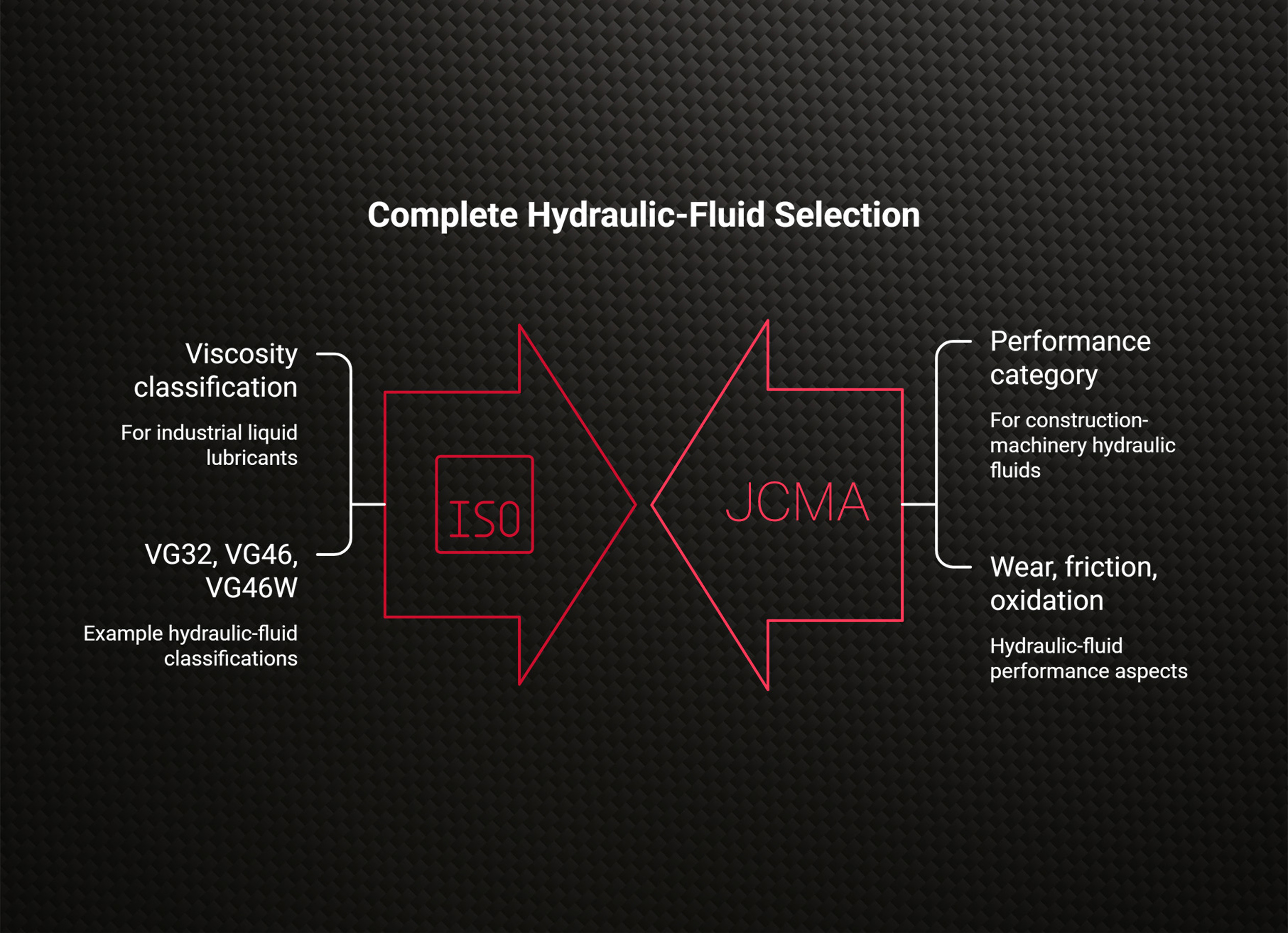
ISO VG identifies a viscosity classification for industrial liquid lubricants. JCMAS HK identifies a construction-machinery hydraulic-fluid performance category.
Consequently, “ISO VG 46” alone does not establish compliance with JCMAS HK. Equally, an HK reference without the required viscosity information is incomplete for product selection. ISO 3448 defines the industrial lubricant viscosity classification.
The distinction is visible in the official filed-fluid list, which records product class and hydraulic-fluid classification separately. Entries include HK fluids with classifications such as VG32, VG46 and VG46W.
Keep the complete designation when reviewing a recommendation. Removing a suffix or assuming that every product in a range has the same classification can obscure relevant differences. The official filed-fluid list provides these separate fields.
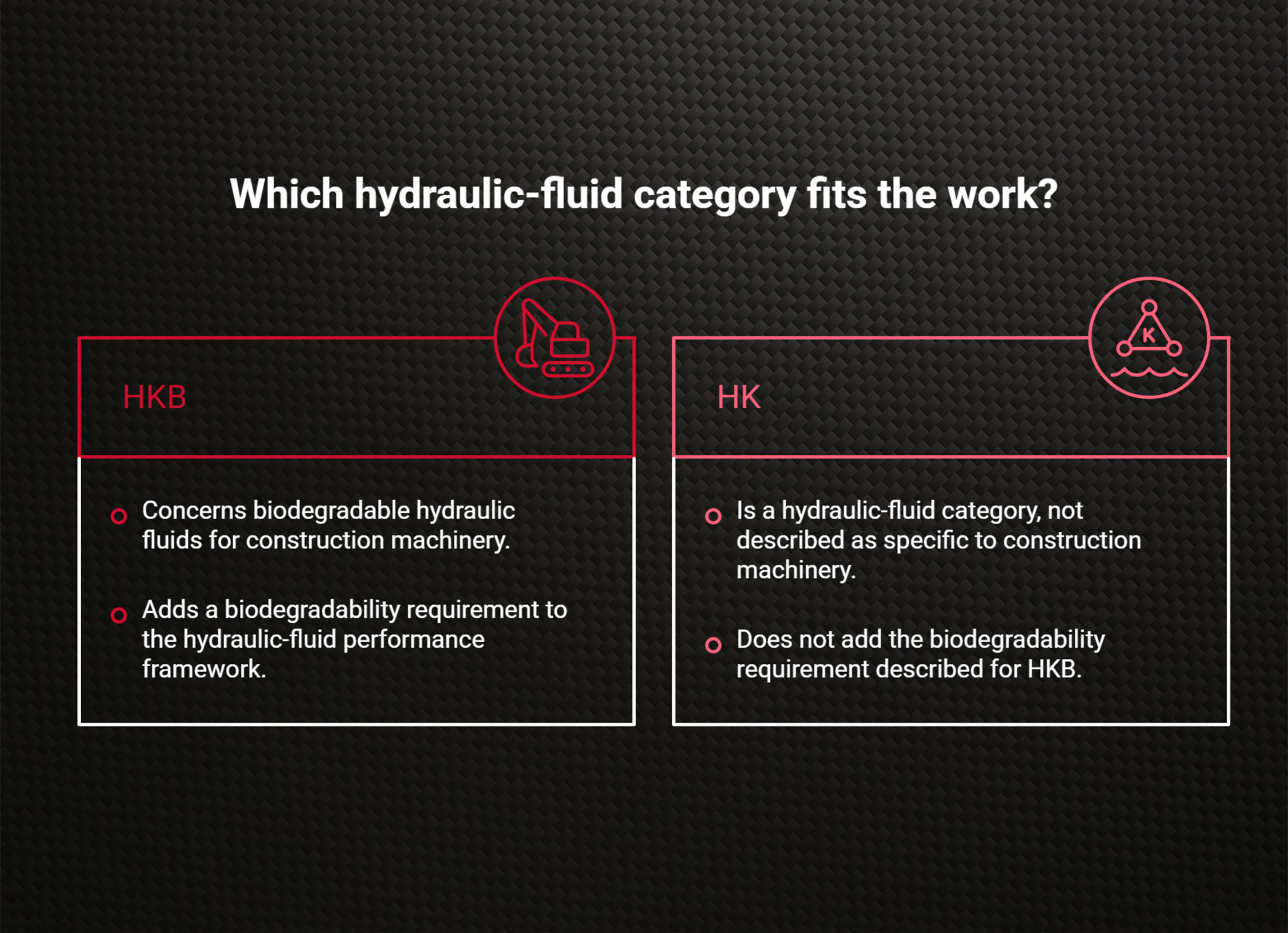
HKB concerns biodegradable hydraulic fluids for construction machinery. Its development added a biodegradability requirement to the hydraulic-fluid performance framework.
HKB should therefore be treated as a distinct application category, rather than simply a higher grade of HK. The correct choice depends on the equipment requirements and any environmental criteria specified for the work.
The designation alone should not be used to infer unrestricted mixing compatibility or suitability for an existing hydraulic system. Those questions require product-specific and equipment-specific guidance.
The JCMA hydraulic-fluid system includes an on-file reporting process and a published list of filed products.
However, the implementation manual states that responsibility for product quality, performance and marking rests with the submitting party. The implementation panel does not guarantee the quality or performance of filed products.
Three statements should therefore remain distinct:
A supplier claims that a product meets a JCMAS requirement.
The exact product appears on the official filed-fluid list.
An equipment manufacturer has issued a documented approval.
These statements are not interchangeable. In particular, filing is not a blanket equipment-manufacturer approval. The implementation manual explains these responsibilities.
When checking a filing, compare the commercial name, submitter, oil code, product class and fluid classification. The list dated 1 October 2026 includes each of these details.
JCMAS documents have been revised since the original hydraulic-fluid standards were introduced.
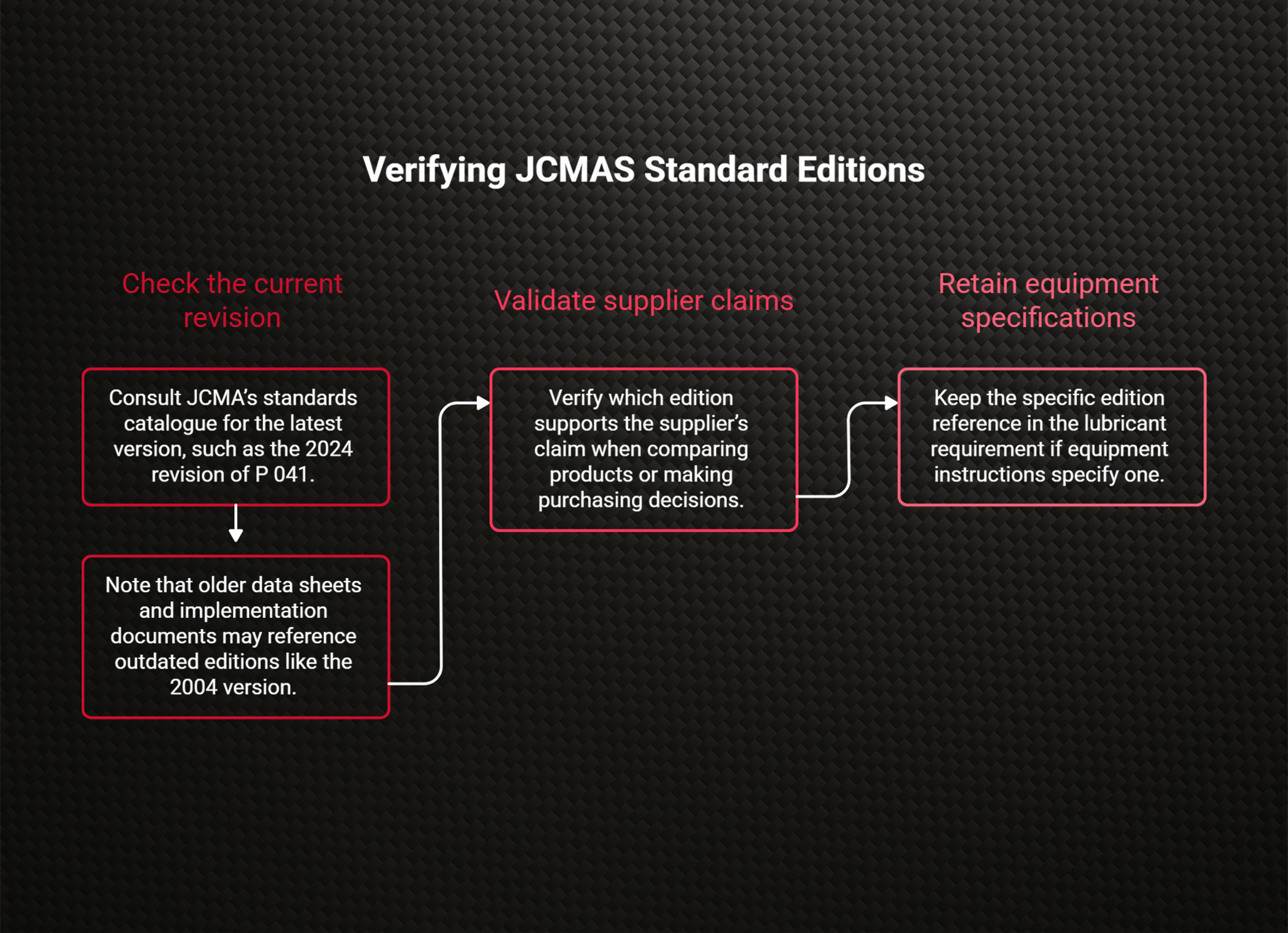
JCMA’s standards catalogue lists a 2024 revision of P 041, while the publicly accessible English implementation manual described above still references the 2004 edition. Older data sheets and implementation documents should therefore not automatically be treated as evidence of conformity with the revised standard. JCMA’s catalogue identifies the P 041 revision.
When comparing products or making purchasing decisions, check which edition supports the supplier’s claim. Where equipment instructions specify an edition, retain that reference in the lubricant requirement.
Begin with the machine’s lubrication instructions and identify the exact hydraulic-fluid requirement. Then check:
Standard and category: the applicable JCMAS reference and HK or HKB designation.
Viscosity and classification: the complete grade, including any suffix.
Supplier documentation: the exact conformity statement and supporting edition.
Filing status: the matching entry where on-file status is claimed.
Equipment requirements: any additional approval, compatibility or servicing instructions.
For distributors and maintenance teams, a complete recommendation should preserve all of these details. JCMAS provides a useful framework for construction-machinery lubricants, but reliable selection depends on matching the documented requirement to the exact product being supplied.