

JASO specifications help identify lubricants suited to particular engine and drivetrain requirements. They are especially familiar on motorcycle oils, where codes such as MA2, MB and FD describe different performance characteristics.
For distributors, workshops and riders, understanding these distinctions is essential. A four-stroke motorcycle with a wet clutch has different lubrication requirements from a scooter with a separate clutch arrangement or a two-stroke engine.
JASO stands for Japanese Automotive Standards Organization. Its automotive standards include several distinct engine oil families.
The most familiar motorcycle classifications are:
JASO T 903: four-stroke motorcycle engine oils, including MA, MA1, MA2 and MB.
JASO M 345: two-stroke petrol engine oils, including FB, FC and FD.
JASO also covers automotive diesel and passenger-car petrol oils. These families address different applications, so their letters should always be read in context.
Many four-stroke motorcycles use one lubricant for the engine, gearbox and wet clutch. A wet clutch operates in oil, making the lubricant’s friction characteristics important to clutch engagement.
An oil must lubricate moving components while allowing the clutch to transmit torque correctly. A passenger-car performance claim alone does not establish that balance. Yamaha explains that motorcycle oil requirements include friction characteristics affecting wet-clutch slip, which are addressed by JASO T 903. Yamaha’s technical explanation describes this distinction.
JASO T 903:2023 combines engine oil performance and physical-property requirements with clutch-friction testing.
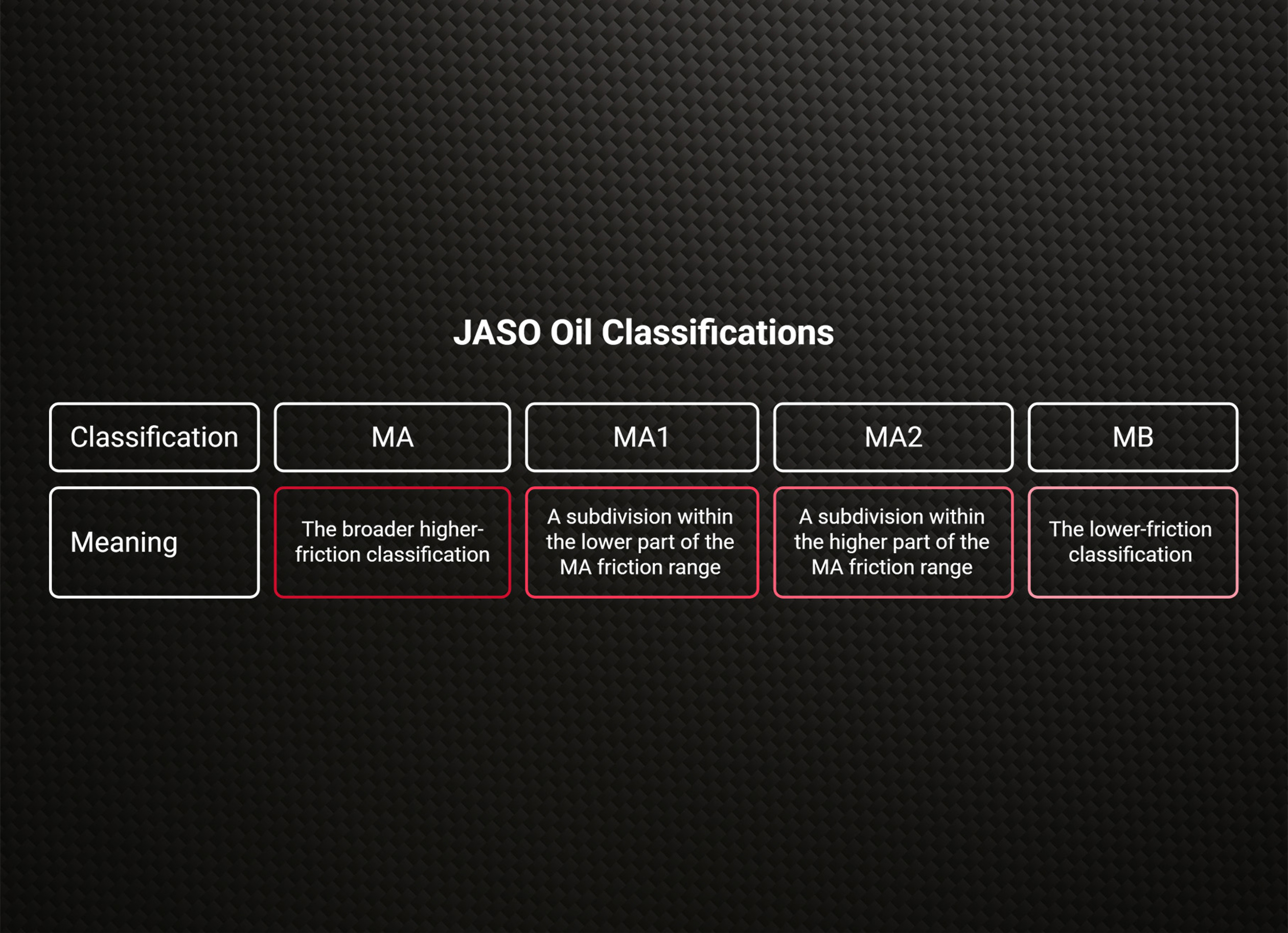
Classification | Meaning |
MA | The broader higher-friction classification |
MA1 | A subdivision within the lower part of the MA friction range |
MA2 | A subdivision within the higher part of the MA friction range |
MB | The lower-friction classification |
Classification uses three indices: dynamic friction, static friction and stop time. An MA oil does not necessarily qualify as MA1 or MA2 because its individual results may fall across the two subdivisions. The JASO T 903 implementation manual defines the classification rules.
MA2 describes a particular clutch-friction range. It is not a universal ranking of overall oil quality.
Where a manufacturer requires MA2, select an oil meeting that requirement. MB serves different friction requirements and should not be substituted merely because the viscosity matches.
MB is commonly associated with scooters without a wet clutch lubricated by the engine oil. However, the word “scooter” alone is insufficient for selection: the manufacturer’s instructions remain decisive. Yamaha’s classification guidance connects these categories with clutch behaviour.
Two-stroke oils have a separate classification system. JASO M 345 evaluates lubricity, detergency, exhaust smoke and exhaust-system blocking.
In the published M 345:2024 implementation manual:
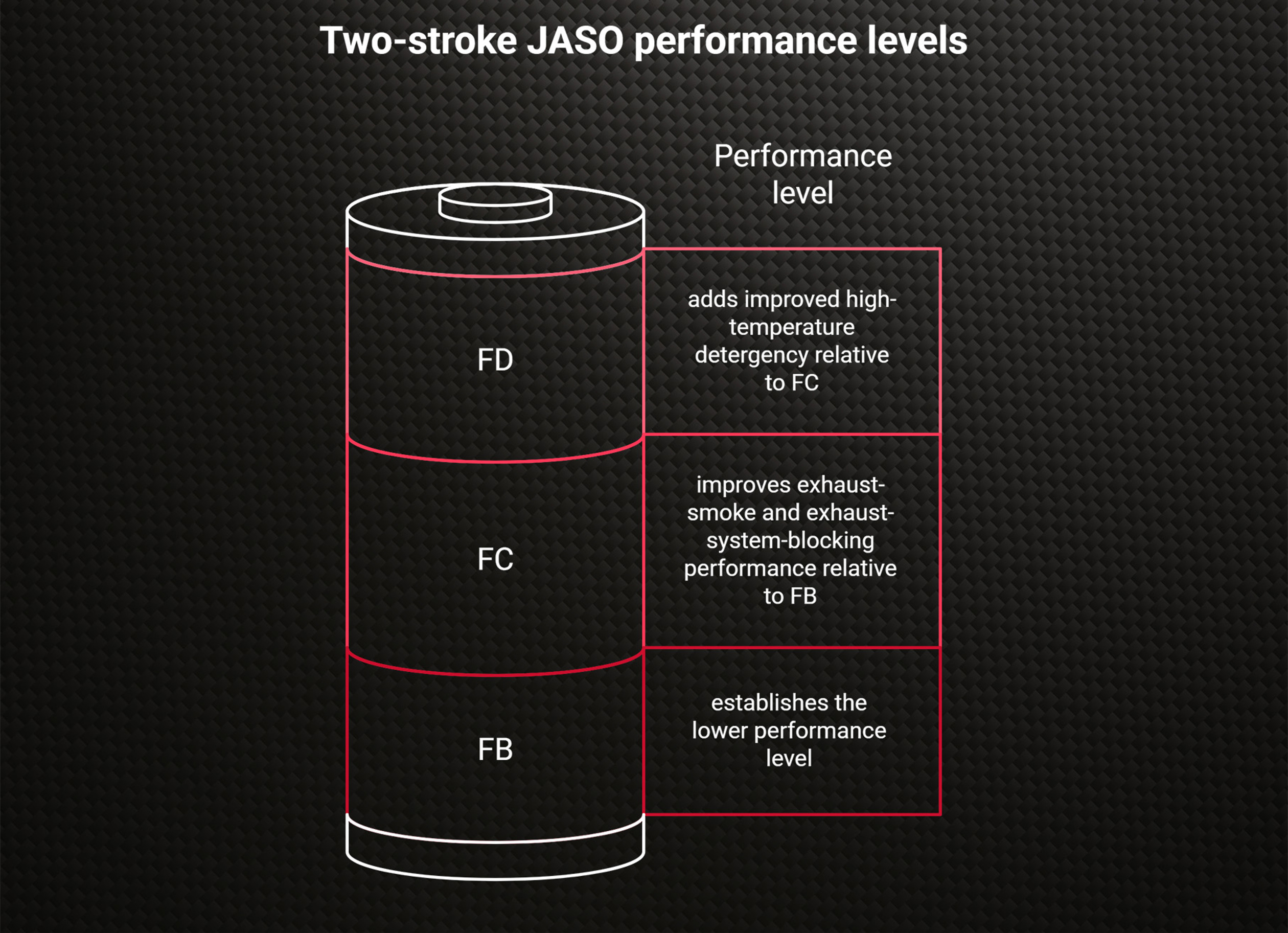
FB establishes the lower performance level among the three classifications.
FC improves exhaust-smoke and exhaust-system-blocking performance relative to FB.
FD adds improved high-temperature detergency relative to FC.
FD’s distinction therefore includes cleanliness performance; it should not be described simply as a “smokeless” oil. These comparisons are explained in the JASO two-stroke implementation manual.
The classification also does not specify the fuel-to-oil mixing ratio for every engine. Follow the equipment manufacturer’s instructions and verify the product’s suitability for premix or oil-injection use.
JSAE lists a newer JASO M 345:2026 edition, while the publicly available JALOS implementation page still links to the 2024 manual. Standard publication and filing arrangements should therefore be checked separately when reviewing supplier documentation. The category comparisons above refer specifically to the published 2024 manual. JSAE’s standard listing and the JALOS implementation page identify those documents.
JASO is also relevant to automotive lubricant portfolios.
Under JASO M 355:2024, diesel classifications include DH-1, DH-2, DH-2F, DL-0, DL-1 and DL-2. DH-2 and DH-2F address heavy-duty applications, while DL-1 and DL-2 address light-duty applications with exhaust aftertreatment. The exact category must match the engine’s requirements. The automotive diesel implementation manual explains their scope.
The separate GLV family addresses passenger-car petrol-engine oils and fuel-economy objectives. A GLV designation does not establish motorcycle wet-clutch suitability. JAMA’s GLV-2 guidance describes this automotive application.
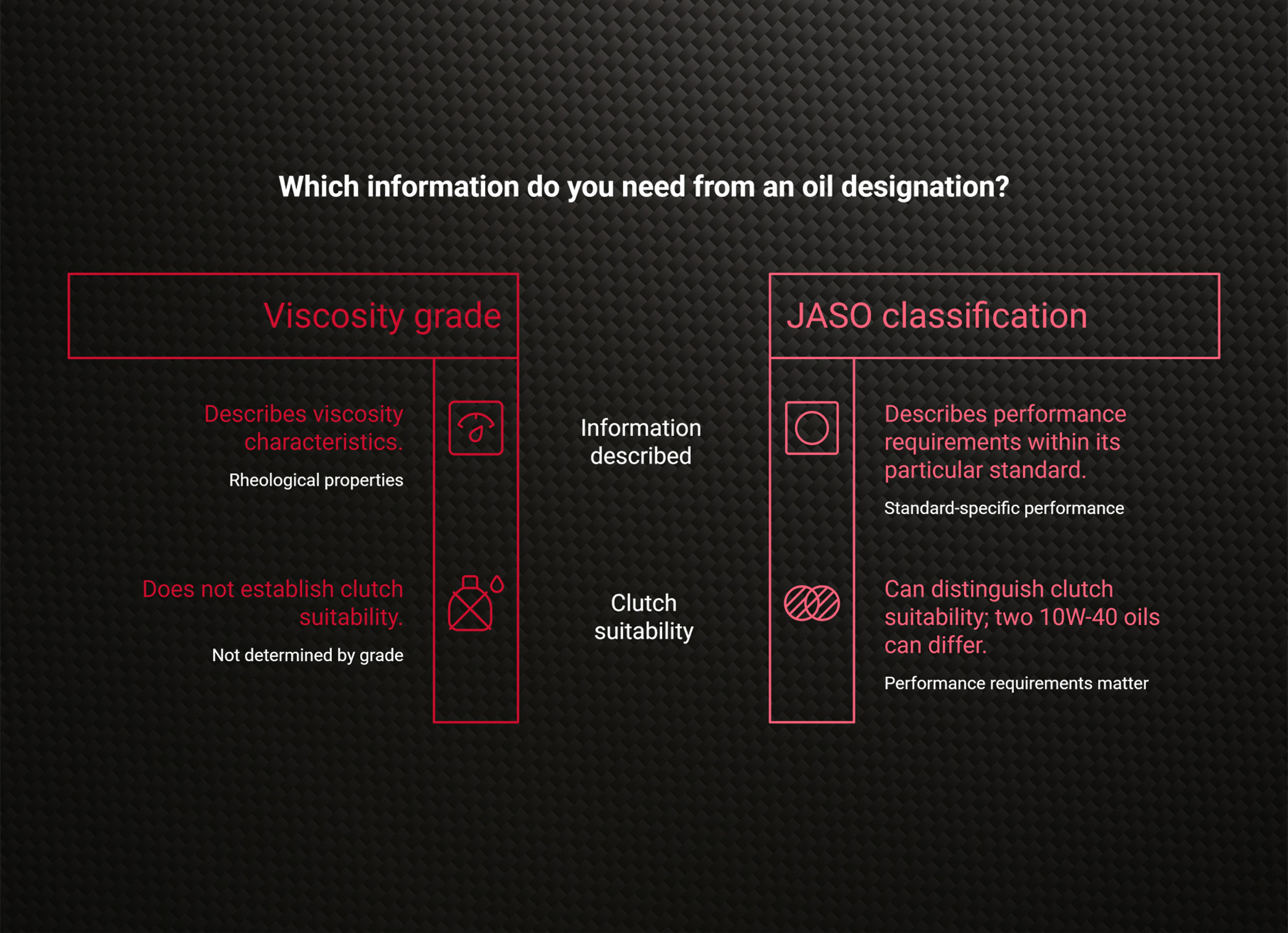
A viscosity grade such as 10W-40 describes viscosity characteristics. A JASO classification describes performance requirements within its particular standard.
Two 10W-40 oils can therefore differ in clutch suitability. Likewise, a two-stroke FD claim and a four-stroke MA2 claim describe entirely different applications.
SAE J300 classifies engine oils by rheological properties and does not establish their complete performance capability. SAE’s scope statement makes this distinction clear.
The JASO on-file system records supplier submissions. It should not be presented as independent product approval by the JASO Engine Oil Standards Implementation Panel.
The supplier remains responsible for the oil’s quality, performance and labelling. The four-stroke implementation manual explicitly prohibits advertising that implies the Panel has approved or certified the product’s performance. The filing rules explain these responsibilities.
For purchasing teams, check the exact product name, viscosity, classification and oil code against the relevant filing information. Keep the supporting technical data sheet current.
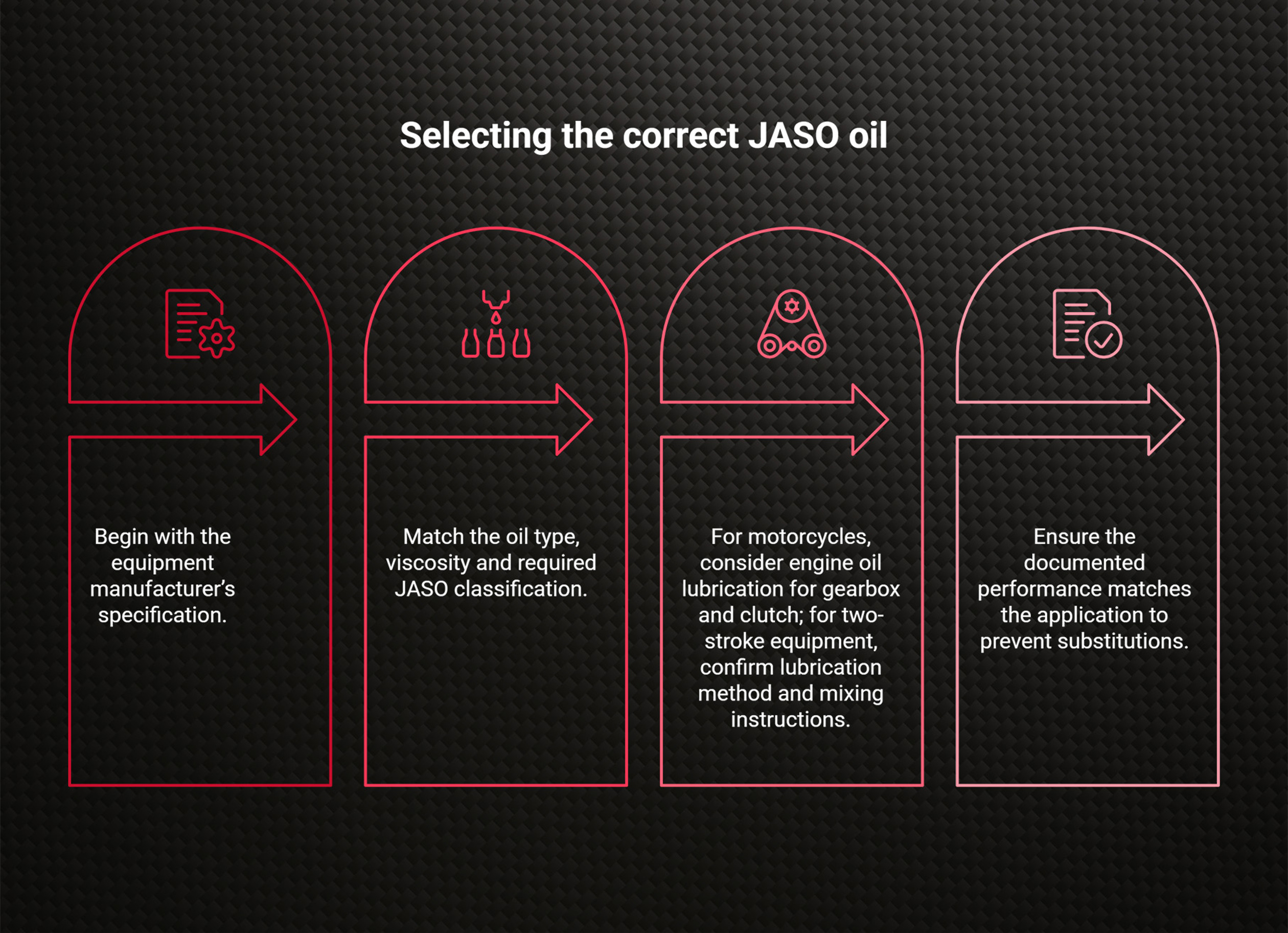
Begin with the equipment manufacturer’s specification, then match the oil type, viscosity and required JASO classification. For motorcycles, consider whether the engine oil also lubricates the gearbox and clutch. For two-stroke equipment, confirm the lubrication method and prescribed mixing instructions.
Clear documentation helps prevent substitutions based only on brand, viscosity or a supposedly “higher” category. The correct JASO oil is the one whose documented performance matches the application.