

DIN specifications appear on many hydraulic oils, industrial gear oils and lubricating greases. References such as DIN 51524-2 or DIN 51517-3 help identify the technical requirements a lubricant claims to meet.
For distributors, workshops and maintenance teams, these references provide a useful basis for comparing products. However, selecting the correct lubricant also requires the right viscosity, application suitability and any equipment-manufacturer requirements.
Understanding what each DIN reference covers makes product data sheets easier to interpret and helps avoid unsuitable substitutions.
DIN stands for Deutsches Institut für Normung, the German Institute for Standardization. It develops standards through committees involving industry and other interested parties.
In lubrication, DIN documents serve different purposes. Some define minimum performance requirements, while others establish classification systems, designations or test methods. Consequently, a DIN number should always be read together with its title, part number and applicable edition.
The expression “DIN specifications” is commonly used for these requirements. However, DIN SPEC is also the name of a distinct document type with a different development process from a DIN standard. The terms are not automatically interchangeable. DIN explains these distinctions in its introduction to standards.
The DIN 51524 series defines minimum requirements for three hydraulic-oil categories:
Standard | Category | Main distinction |
DIN 51524-1 | HL | Protection against corrosion and oil ageing |
DIN 51524-2 | HLP | Anti-wear properties in addition to corrosion and ageing protection |
DIN 51524-3 | HVLP | Anti-wear hydraulic oils with improved viscosity-temperature behaviour |
DIN lists June 2017 editions for Part 1: HL, Part 2: HLP and Part 3: HVLP.
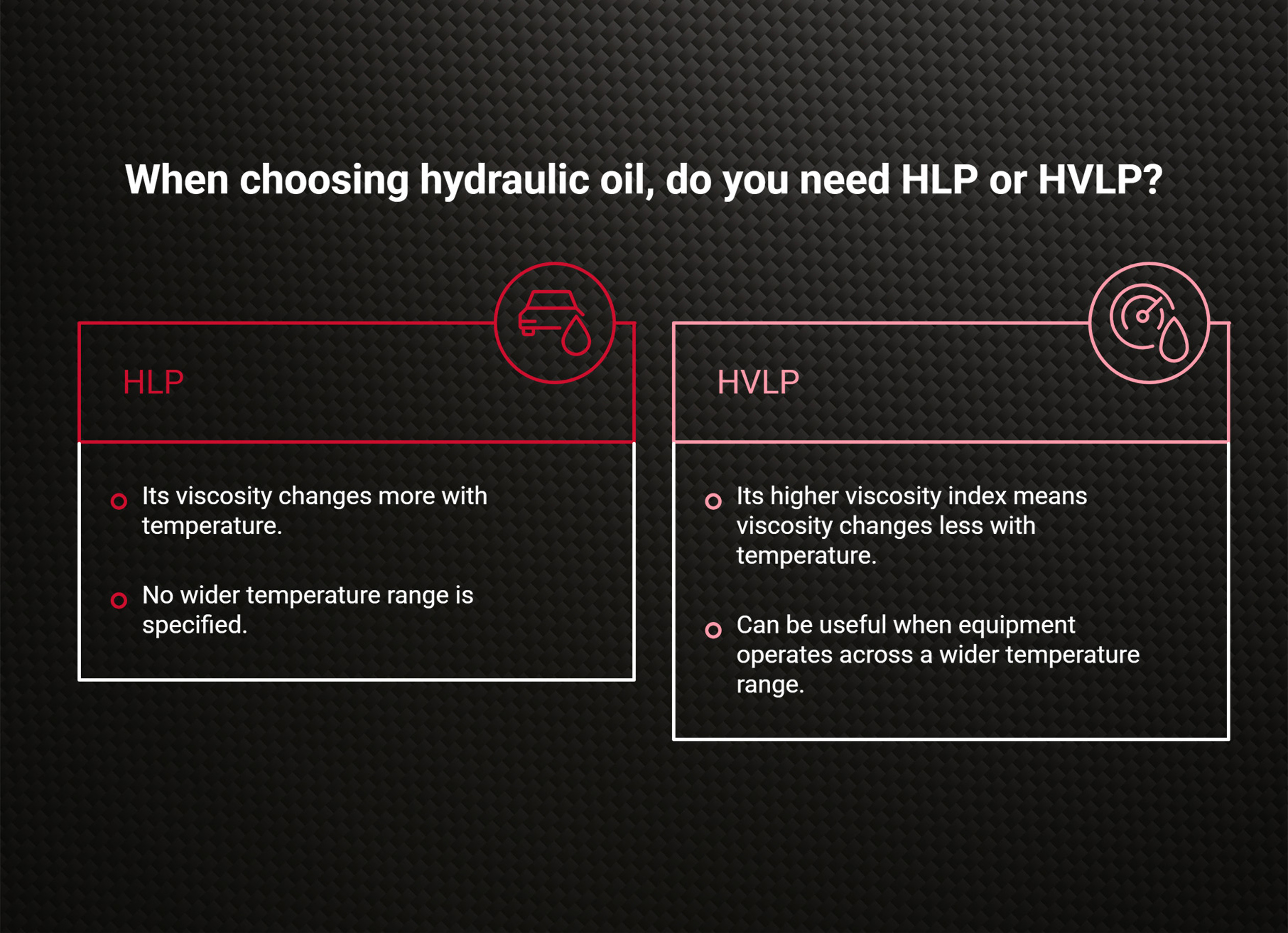
HLP oils address hydraulic applications requiring wear protection alongside resistance to corrosion and ageing. DIN 51524-2 covers systems where pump or hydraulic-motor design and operating conditions require additives that reduce wear under mixed-friction conditions.
The HLP designation is therefore relevant to lubricant performance. It does not specify the viscosity grade on its own.
HVLP oils combine anti-wear performance with a higher viscosity index. This means their viscosity changes less with temperature, which can be useful when equipment operates across a wider temperature range.
HVLP should not be treated as a universal replacement for HLP. The equipment’s operating requirements still determine the appropriate fluid. For example, hydraulic-equipment manufacturer HAWE distinguishes these categories and provides application restrictions rather than treating them as an unrestricted quality ladder. HAWE’s oil recommendations explain the practical differences.
A designation such as HLP 46 combines two pieces of information:
HLP identifies the hydraulic-oil category.
46 identifies the ISO viscosity grade.
Likewise, CLP 220 combines a lubricant category with an ISO viscosity grade.
ISO VG is the viscosity classification system for industrial liquid lubricants, defined in ISO 3448. It does not establish the complete performance requirements for a hydraulic oil or gear oil.
This distinction matters when comparing products. Two oils can share an ISO viscosity grade while belonging to different application categories. Conversely, products meeting the same DIN performance standard can be available in several viscosity grades.
A purchasing specification should therefore state both the required performance category and viscosity grade. “ISO VG 46” alone does not fully describe the required hydraulic lubricant.
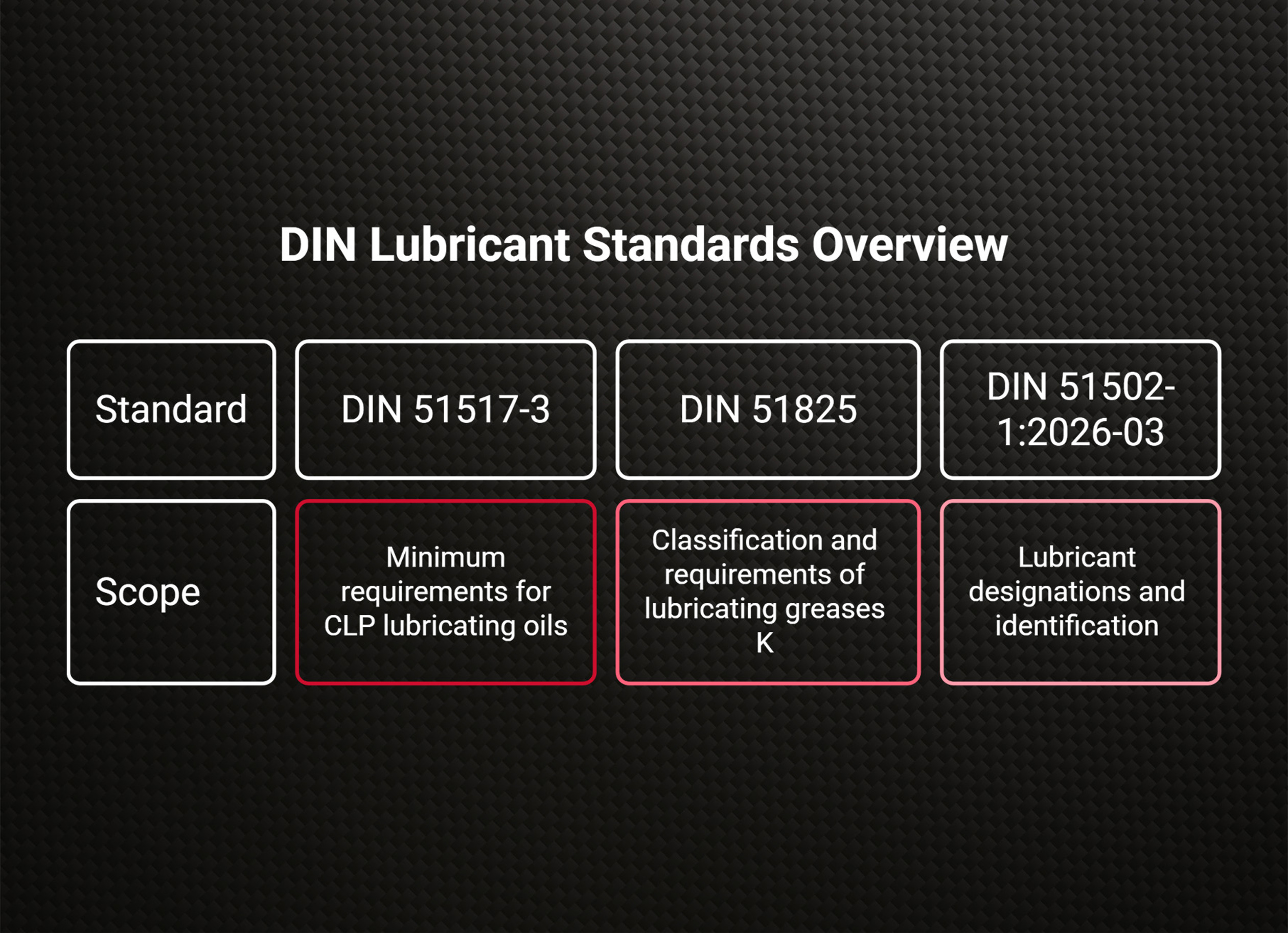
DIN 51517 is another important series in industrial lubrication. DIN 51517-3 defines minimum requirements for CLP lubricating oils, principally intended for circulation and splash lubrication.
CLP references commonly appear on industrial gear-oil data sheets. The standard reference identifies a set of requirements; it does not establish that every CLP oil is suitable for every gearbox.
The September 2018 edition includes provisions concerning seal-material behaviour and foam testing, illustrating why performance assessment extends beyond viscosity. DIN Media describes the scope and changes in DIN 51517-3:2018-09.
Edition status also deserves attention. As of October 2026, DIN lists a July 2026 draft revision for Part 3 alongside the published 2018 standard. A draft should not be presented as an adopted replacement merely because it has a newer date.
DIN requirements also cover greases. DIN 51825 addresses the classification and requirements of lubricating greases K. It is a separate standard from those used for hydraulic and industrial lubricating oils. DIN Media identifies its scope as “Lubricating greases K — Classification and requirements”.
When reviewing a grease recommendation, retain the complete designation and application requirements. A shortened description can omit information needed to assess whether the product meets the equipment’s lubrication instructions.
The same principle applies across lubricant types: compare the full specification, rather than selecting a product because one familiar number or letter appears on its label.
Classification documents serve a different purpose from minimum-performance standards.
The DIN 51502 series concerns lubricant designations and identification. DIN 51502-1:2026-03 covers general information, including abbreviated designations and identification on packaging, containers, lubrication equipment, lubrication points and product data sheets.
This is a relevant update for technical documentation: DIN reports that the former DIN 51502:1990-08 was revised and divided into an eight-part series. Older reference charts may therefore cite the previous single document. DIN Media explains the revised DIN 51502 structure.
A classification reference helps describe a lubricant. It should be read alongside the applicable performance requirements.
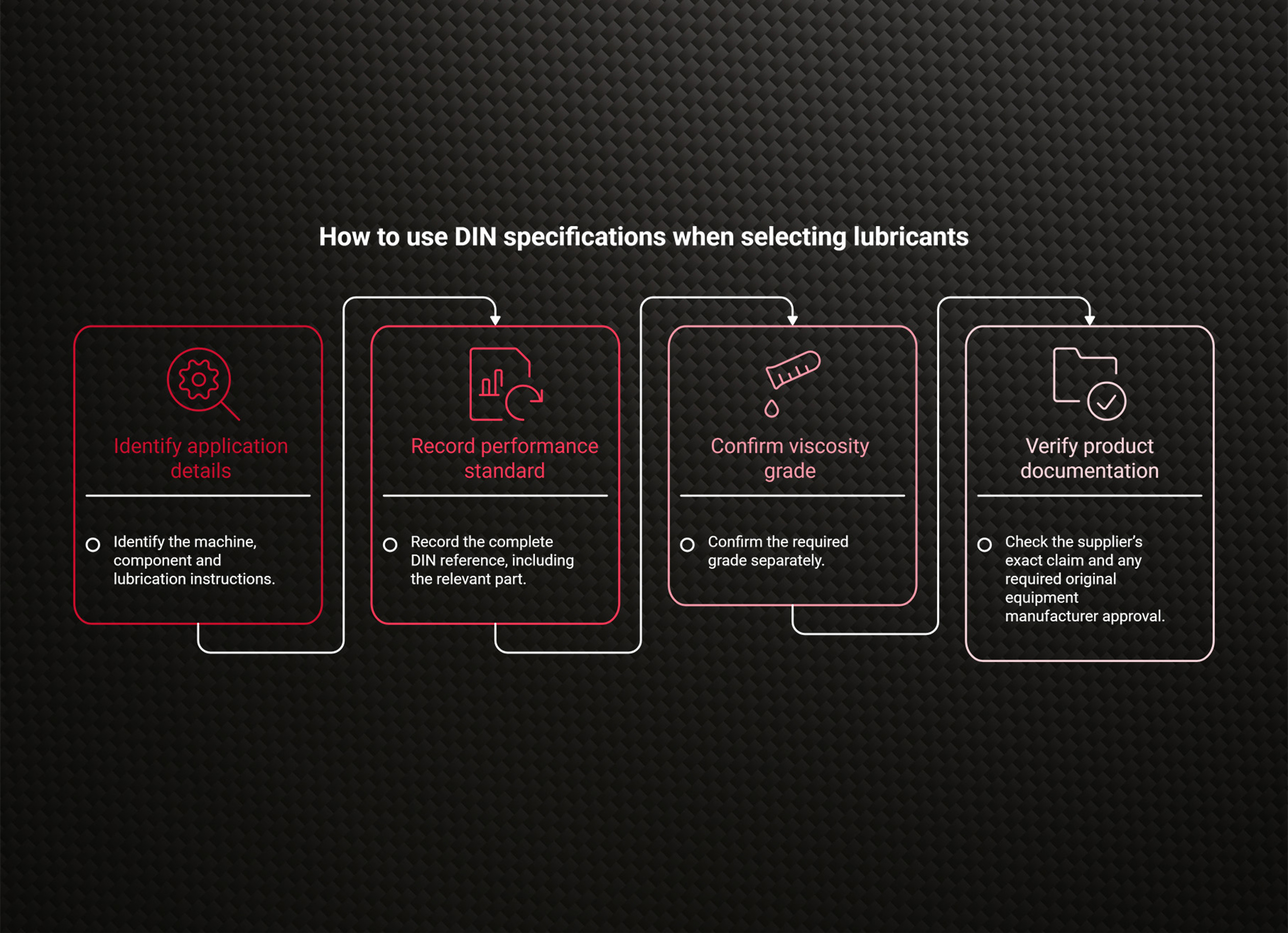
For a clear, reviewable product recommendation, check four elements together:
Application: identify the machine, component and lubrication instructions.
Performance standard: record the complete DIN reference, including the relevant part.
Viscosity: confirm the required grade separately.
Product documentation: check the supplier’s exact claim and any required original equipment manufacturer approval.
Keep wording precise. A supplier’s statement that a product “meets DIN 51524-2” should not be rewritten as an equipment-manufacturer approval. Similarly, a shared DIN reference alone does not demonstrate that two products can be mixed or substituted in a particular machine.
For distributors and maintenance teams, DIN specifications are most useful when recorded as part of a complete lubricant requirement. Combining the correct standard, viscosity grade and equipment instructions provides a much stronger basis for selection than relying on a product name or a single classification code.