
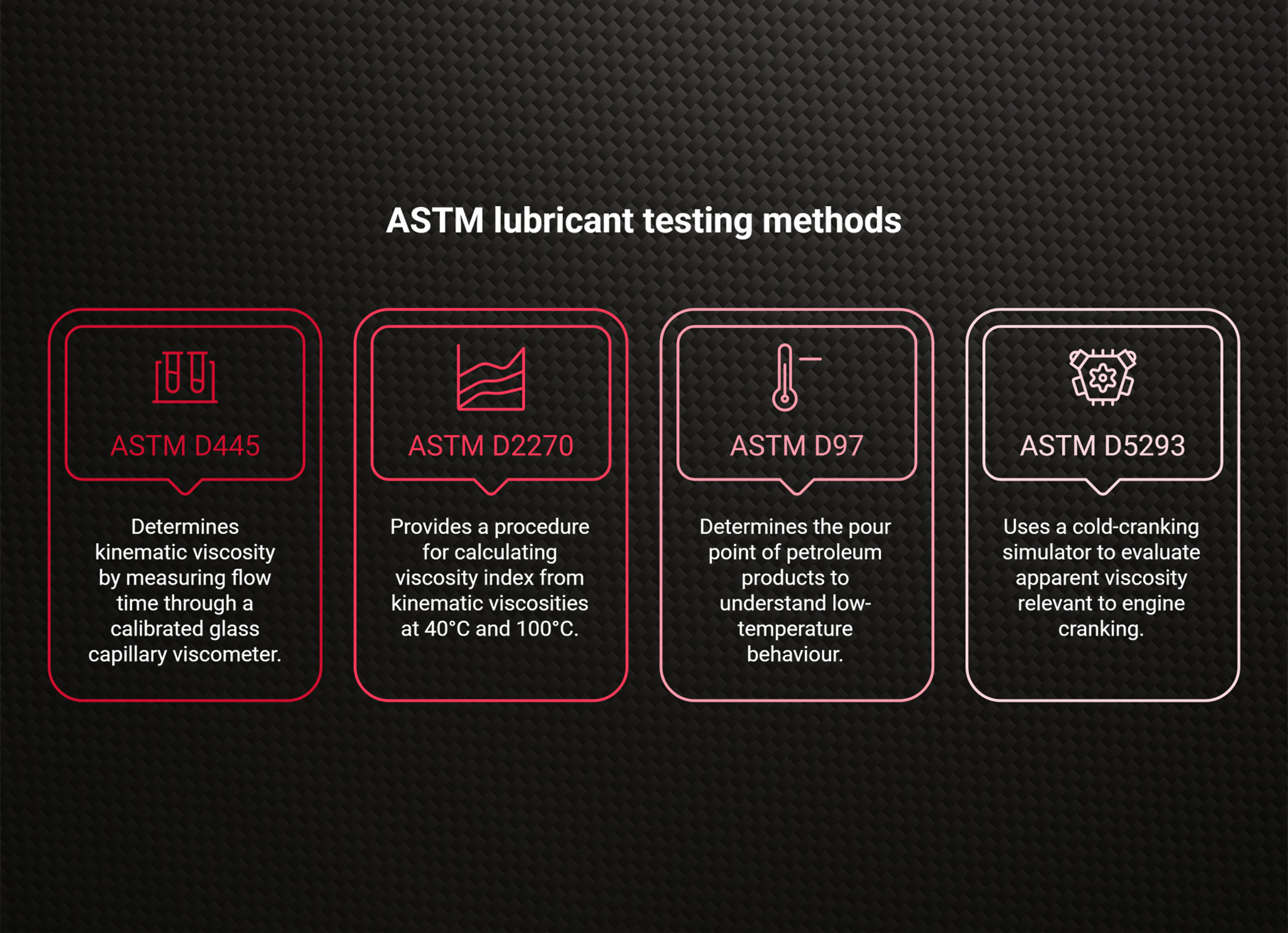
ASTM references appear throughout lubricant technical data sheets. Codes such as ASTM D445, D2270 and D97 identify standardised procedures used to assess properties including viscosity, viscosity index and pour point.
For distributors, workshops and maintenance teams, these references make technical information easier to interpret. However, a test-method reference does not automatically mean that an oil has passed a performance specification or received an equipment-manufacturer approval.
Understanding what ASTM standards measure—and what their results establish—is essential when comparing lubricants.
ASTM International publishes technical standards covering materials, products, testing procedures and performance requirements. In lubrication, several types of document are relevant:
Test methods explain how to measure a property under defined conditions.
Practices describe procedures, such as calculating viscosity index.
Specifications establish requirements for a defined product or application.
For example, ASTM D445 is a test method for kinematic viscosity, while ASTM D4485 is a specification addressing engine-oil performance.
This distinction matters when reading a data sheet. “Tested according to ASTM D445” identifies the measurement procedure. It does not provide a universal pass/fail result or establish that the oil is suitable for a particular engine.
ASTM reference | Property or subject | What the reference helps explain |
D445 | Kinematic viscosity | Oil flow characteristics at a stated temperature |
D2270 | Viscosity index | How kinematic viscosity changes with temperature |
D97 | Pour point | Low-temperature flow behaviour under the specified procedure |
D92 | Flash and fire points | Behaviour when exposed to heat and a test flame |
D892 | Foaming characteristics | Foam tendency and stability under defined test conditions |
D4485 | Engine-oil performance | Requirements associated with active API service-category engine oils |
The method, result, units and test conditions should be read together. A number without this context can be misleading.
ASTM D445 determines kinematic viscosity by measuring the time a liquid takes to flow under gravity through a calibrated glass capillary viscometer.
Lubricant data sheets commonly report kinematic viscosity at 40°C and 100°C, expressed in mm²/s, also called centistokes or cSt. The temperature is essential: a value measured at 40°C cannot be compared directly with one measured at 100°C.
Viscosity helps determine whether an oil is appropriate for an application, but it does not establish every aspect of lubricant performance. Oils with similar viscosity can have different formulations and performance claims. ASTM D445 describes the measurement and its application.
ASTM D2270 provides a procedure for calculating viscosity index, usually abbreviated to VI, from kinematic viscosities at 40°C and 100°C.
A higher VI indicates a smaller decrease in kinematic viscosity as temperature increases over that reference range. This helps describe temperature-dependent behaviour.
VI is different from viscosity grade. Two oils can share a viscosity grade while having different viscosity indices. A higher VI also does not, on its own, prove better wear protection or suitability for every machine. ASTM explains the meaning and calculation of viscosity index in D2270.
ASTM D97 determines the pour point of petroleum products. It provides information about low-temperature behaviour under a defined laboratory procedure.
Pour point should not be treated as a universal minimum operating temperature. Equipment may require adequate cranking, pumping or circulation performance before that temperature is reached.
For engine oils, separate methods assess other aspects of cold behaviour. ASTM D5293, for example, uses a cold-cranking simulator to evaluate apparent viscosity relevant to engine cranking. A pour-point result is not a substitute for this measurement.
Method identification also matters: ASTM states that automated pour-point procedures have their own designations and should not simply be reported as D97. See ASTM D97 and ASTM D5293.
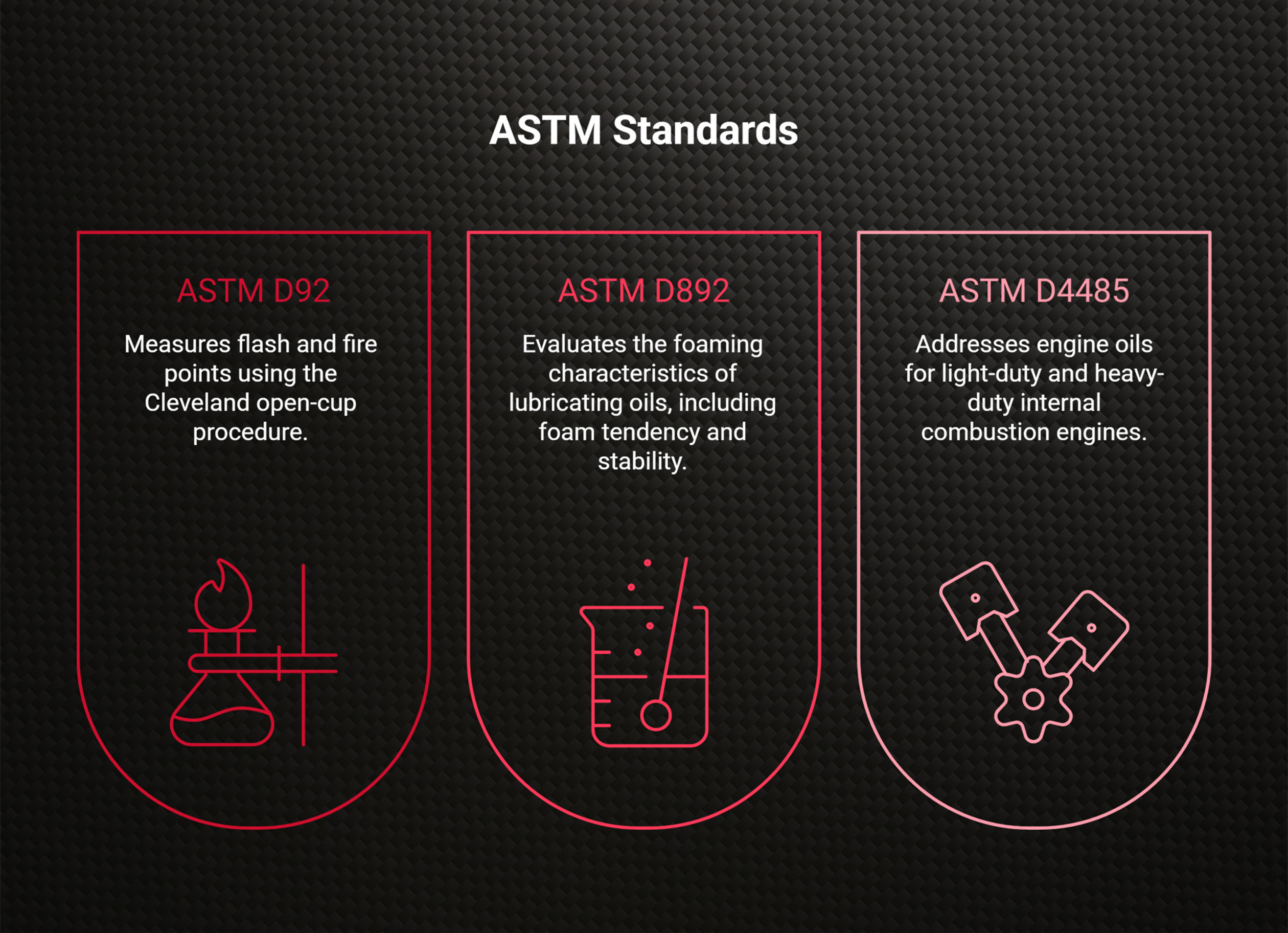
ASTM D92 measures flash and fire points using the Cleveland open-cup procedure.
Flash point describes the tendency of a sample to form a flammable mixture with air under controlled laboratory conditions. Fire point concerns its tendency to sustain combustion.
Neither value should be presented as the lubricant’s maximum recommended operating temperature. The test also does not, by itself, establish the fire risk of an actual installation.
When comparing products, check the method as well as the reported temperature. A flash-point figure needs its test context to be meaningful. ASTM D92 explains these interpretation limits.
ASTM D892 evaluates the foaming characteristics of lubricating oils, including foam tendency and stability.
Foaming can create problems in systems involving high-speed gears, pumping and splash lubrication. The method provides a controlled way to assess this behaviour, but results must be evaluated against the requirements of the relevant application.
A data sheet should retain the test sequence and reporting format. Reducing several results to a single unexplained “foam value” can remove information needed for comparison. ASTM D892 describes the purpose of the foaming assessment.
ASTM publishes performance specifications as well as individual test methods.
ASTM D4485 addresses engine oils for light-duty and heavy-duty internal combustion engines used in vehicles and specified off-highway equipment. It combines engine testing with bench and chemical assessments.
Its scope does not extend to every engine application. ASTM specifically excludes applications such as motorcycles, outboard motors and oceangoing vessels from this specification. ASTM D4485 defines its coverage and limitations.
API references D4485 within its Engine Oil Licensing and Certification System. However, an ASTM test reference is not equivalent to an API licence: authorisation to display API quality marks follows API’s own programme requirements. API explains this relationship.
Begin with the equipment’s required lubricant specification, then use test data to assess the relevant properties.
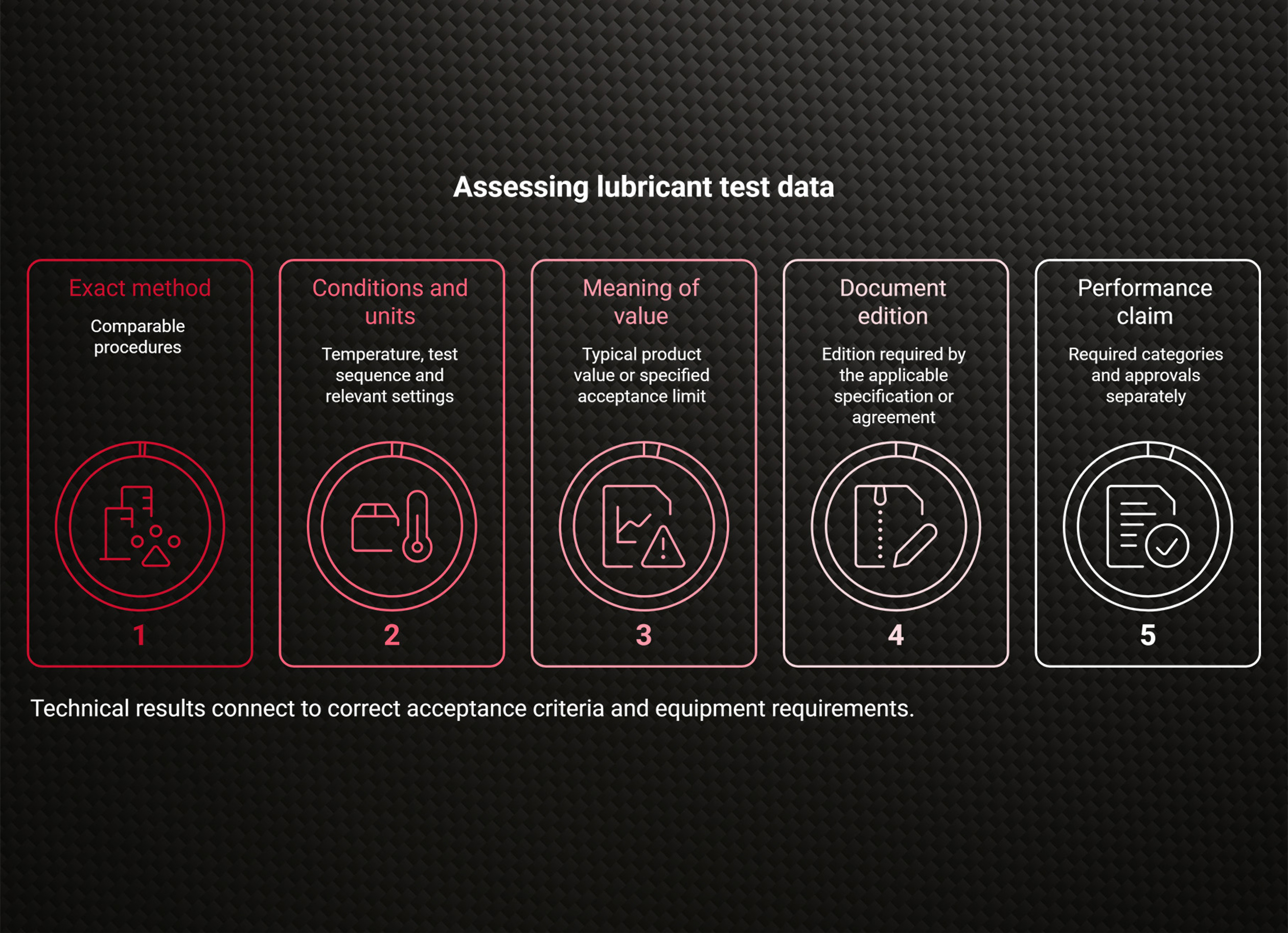
For a sound comparison, check:
The exact method: confirm that both results were obtained using comparable procedures.
The conditions and units: retain temperature, test sequence and other relevant settings.
The meaning of the value: distinguish a typical product value from a specified acceptance limit.
The document edition: use the edition required by the applicable specification or agreement.
The complete performance claim: verify required categories and approvals separately.
For distributors and workshops, ASTM references are valuable because they explain how technical results were obtained. Their practical value comes from connecting those results to the correct acceptance criteria and equipment requirements, rather than treating one favourable measurement as proof of overall lubricant quality.