
API specifications appear on engine oil labels and technical data sheets worldwide. Codes such as API SQ, SP, CK-4 and FA-4 identify performance requirements that help distributors, workshops and fleet operators select suitable lubricants.
Understanding these codes requires more than recognising the newest designation. Petrol and diesel categories follow different compatibility rules, and an API specification must be considered alongside the required viscosity grade and vehicle manufacturer’s instructions.
API stands for the American Petroleum Institute. Its engine oil service categories establish performance requirements developed through cooperation between the lubricant industry, vehicle and engine manufacturers, and technical organisations.
API also operates the Engine Oil Licensing and Certification System, or EOLCS. This voluntary programme authorises qualifying marketers to use API quality marks and includes marketplace monitoring and testing. A performance category describes the requirements an oil meets; licensing provides authorisation to display the associated API marks. API’s EOLCS overview explains the programme.
An SAE grade such as 0W-20, 5W-30 or 15W-40 classifies viscosity characteristics. It does not establish the oil’s complete performance capability. SAE J300 explicitly limits its scope to rheological properties.
This means two 5W-30 oils can serve different applications. Matching the viscosity grade is only one part of selecting the correct product.
For purchasing and stock management, record the viscosity grade, API category and any required original equipment manufacturer—or OEM—specification separately.
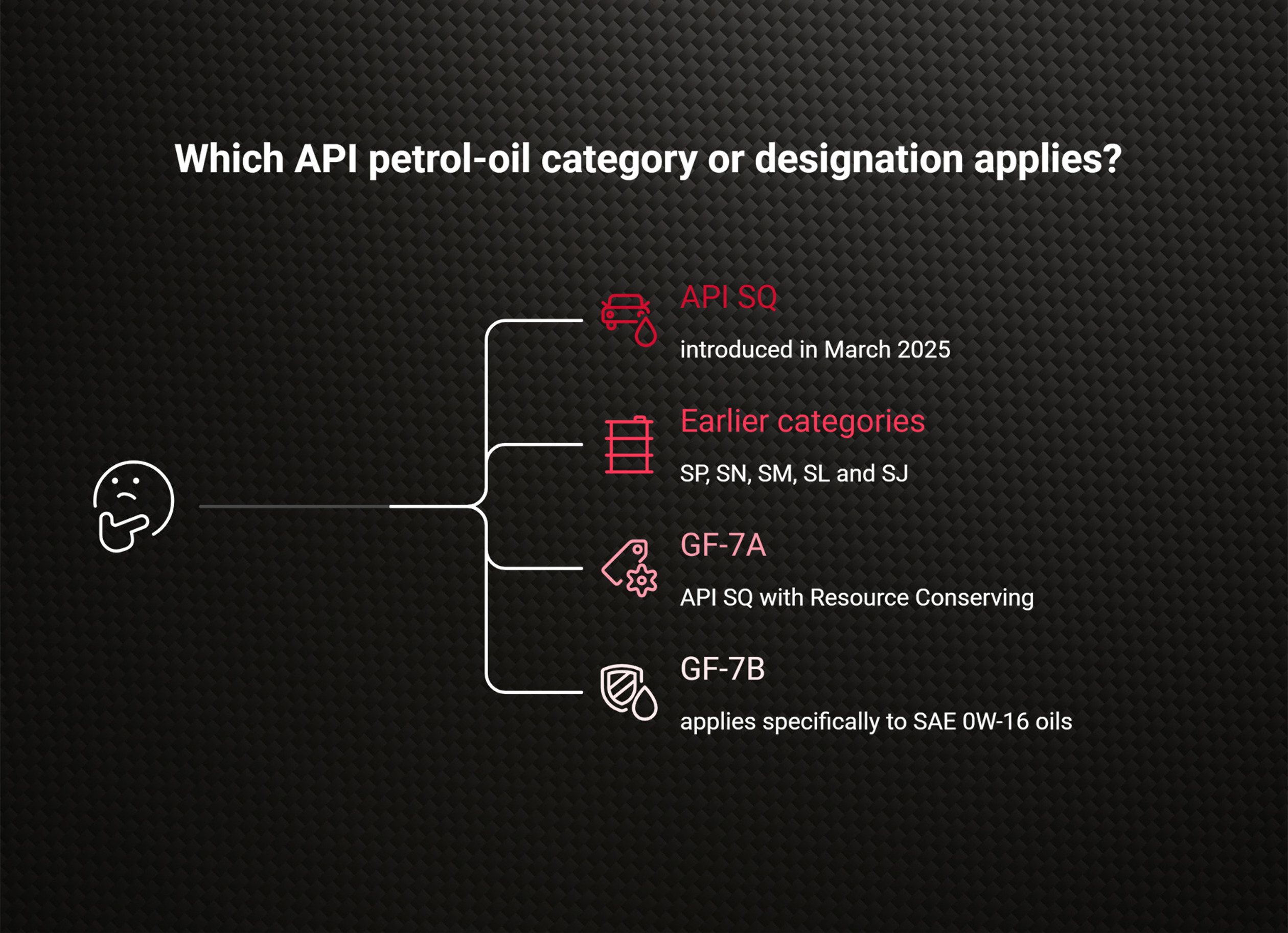
API’s S categories cover automotive petrol engine oils. API SQ, introduced in March 2025, addresses protection against low-speed pre-ignition with both fresh and aged oil, timing-chain wear, high-temperature deposits, sludge and varnish.
API’s guide also lists SP, SN, SM, SL and SJ as current categories for earlier applications. The introduction of SQ therefore does not automatically make every earlier category obsolete.
For automotive petrol engines, newer API categories include the performance properties of earlier categories. An SQ oil can meet an earlier API petrol-category requirement, provided the viscosity and all other applicable manufacturer requirements are satisfied. API’s Motor Oil Guide provides the category descriptions.
ILSAC passenger-car standards connect engine protection with additional requirements, including fuel economy.
API SQ with Resource Conserving corresponds to ILSAC GF-7A. GF-7B applies specifically to SAE 0W-16 oils. The API Starburst identifies GF-7A oils, while the Shield identifies GF-7B oils.
An API SQ claim alone should therefore not be treated as an automatic GF-7A claim. The additional designation matters. API’s guide explains these distinctions.
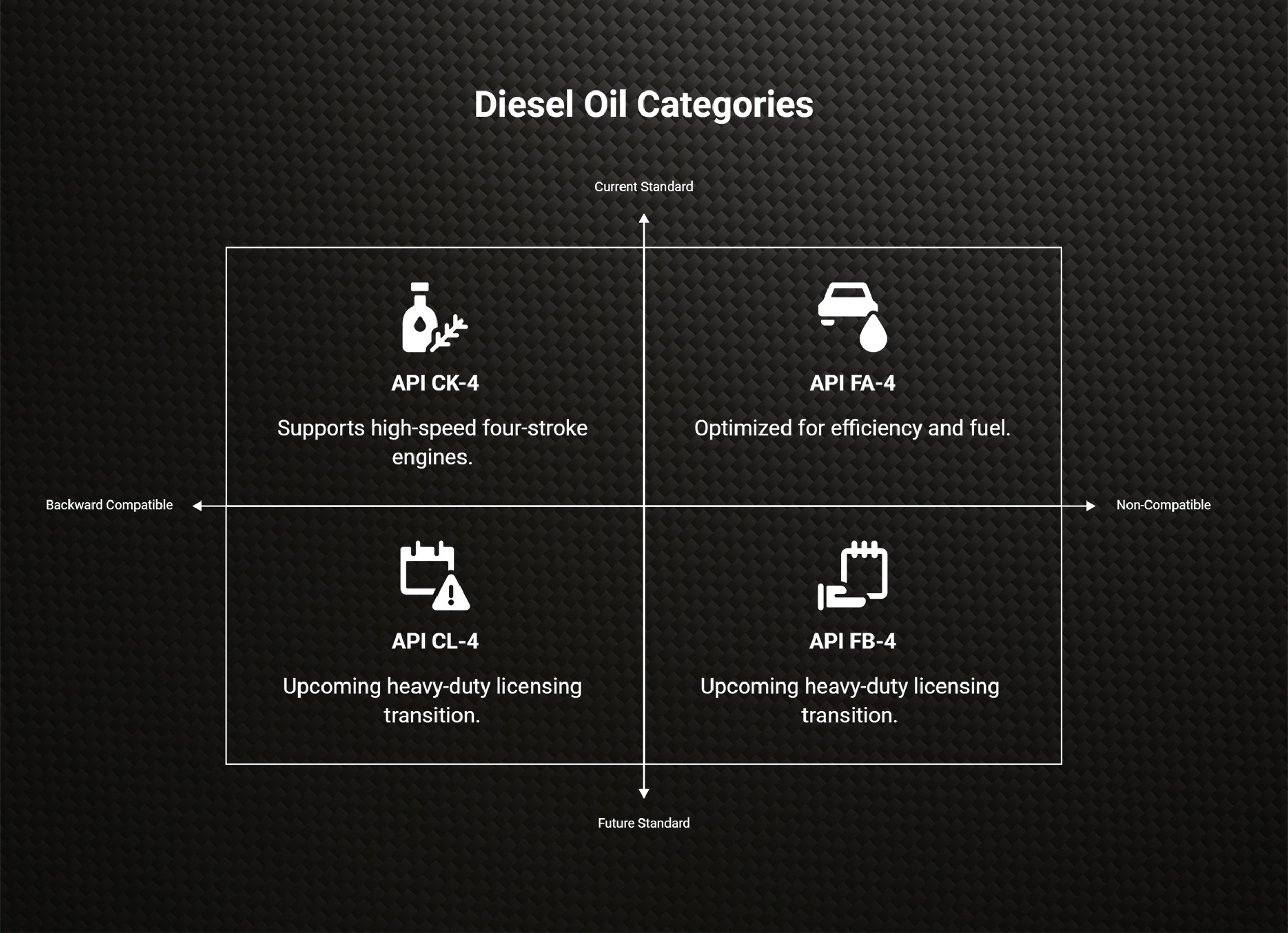
Diesel oil selection requires particular attention to compatibility. CK-4 and FA-4 serve different application requirements.
Category | Application and compatibility |
|---|---|
API CK-4 | High-speed, four-stroke diesel engines, including relevant on-road and non-road applications. Covers the performance requirements of CJ-4, CI-4 with CI-4 PLUS, CI-4 and CH-4. |
API FA-4 | Selected SAE XW-30 oils for manufacturer-authorised on-road diesel applications. Not interchangeable or backward compatible with CK-4 or the earlier categories listed above. |
CK-4 addresses oxidation, shear-related viscosity loss, aeration, wear, deposits and aftertreatment protection.
FA-4 oils have a high-temperature, high-shear viscosity—HTHS—of 2.9–3.2 mPa·s. This supports efficiency objectives in engines designed for their use.
Fuel quality also matters. FA-4 is intended for diesel fuel containing no more than 15 ppm sulphur. For CK-4, fuel above 15 ppm sulphur can affect aftertreatment durability or drain intervals, requiring manufacturer guidance.
These application limits are detailed in API’s oil category descriptions.
The next heavy-duty categories, CL-4 and FB-4, have a first licensing date of 1 January 2027, according to Infineum’s account of the API industry ballot approvals.
As of October 2026, they represent an upcoming licensing transition. Product announcements should be distinguished from an active API licence. Infineum’s PC-12 update describes the agreed timeline.
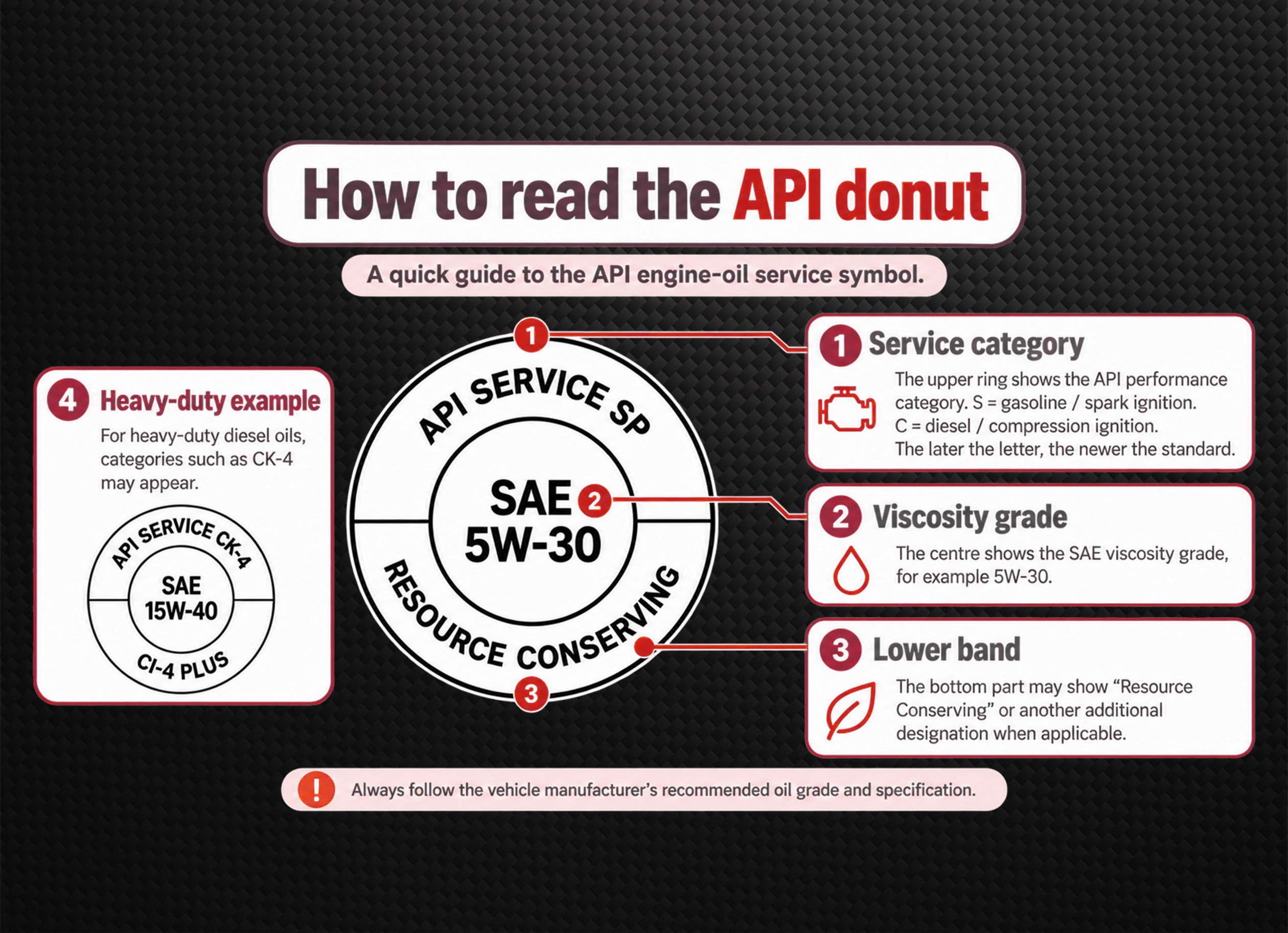
The circular API Service Symbol, commonly called the Donut, brings several pieces of information together:
The upper section identifies the API service category.
The centre displays the SAE viscosity grade.
The lower section may show an applicable additional classification, such as Resource Conserving.
An oil may qualify for both petrol and diesel performance categories. That does not make it universally suitable: the complete vehicle requirements still apply. API’s licensing rules distinguish category compliance from suitability for every engine. API 1509 explains the symbol and its use.
Wording such as “meets API SQ” should not, by itself, be interpreted as confirmation that the product is API-licensed.
When licensing is claimed, distributors can check the company, product brand, viscosity grade and service category against the API EOLCS Licensee Directory. Matching the exact product is more useful than confirming only that its supplier holds a licence.
API licensing is also separate from an OEM approval. Where a manufacturer requires its own approval, that requirement needs independent confirmation.
Start with the applicable vehicle or engine documentation. Establish the required API performance level, permitted SAE viscosity and any additional manufacturer specifications. For diesel equipment, also check fuel restrictions and service conditions before considering a substitution.
Keep current technical data sheets with purchasing and workshop records, and verify licensing whenever it forms part of the product claim.
API specifications provide a useful common language for engine oil performance. Their practical value comes from combining that information with the requirements of the exact engine being serviced.