
AFNOR specifications appear on many lubricant technical data sheets, particularly those for hydraulic oils. References such as NF E48-603, NF E48-690 and NF ISO 11158 help identify performance requirements or testing procedures.
However, these references do not all serve the same purpose. Some describe lubricant performance, others define test methods, and several older documents have been replaced.
For distributors, workshops and maintenance teams, understanding the complete reference—and its status—is essential when comparing products or interpreting equipment manuals.
AFNOR stands for Association française de normalisation, the French standardisation organisation.
In lubricant documentation, “AFNOR specification” commonly refers to a French standard published within the AFNOR system. This may be a national document or the French adoption of a European or international standard.
The prefixes explain the document’s origin:
Prefix | Meaning |
NF | French standard |
NF EN | French adoption of a European standard |
NF ISO | French adoption of an international ISO standard |
NF EN ISO | ISO standard adopted at European and French levels |
These prefixes do not create a ranking of lubricant quality. They identify the standards framework. AFNOR explains the different prefixes in its standards FAQ.
The number, edition and applicable category provide the information needed to understand the actual requirement.
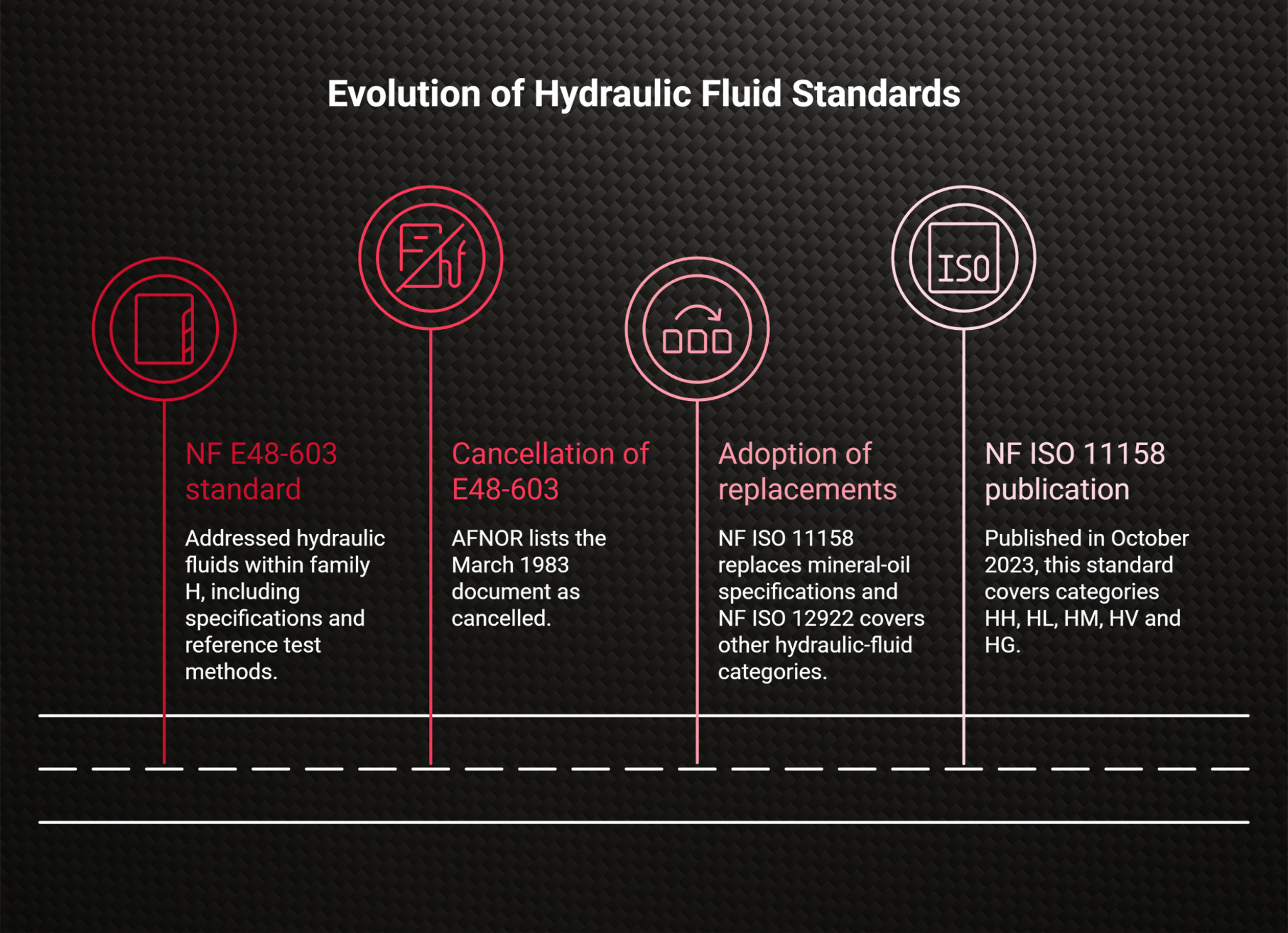
E48-603 addressed hydraulic fluids within family H, including specifications and reference test methods. Lubricant data sheets frequently cite it as AFNOR NF E48-603, sometimes followed by a category such as HM or HV.
An important qualification is that AFNOR lists the March 1983 document as cancelled.
Its catalogue identifies replacement documents in two areas: NF ISO 11158 for mineral-oil hydraulic-fluid specifications and NF ISO 12922 for other hydraulic-fluid categories, including fire-resistant fluids. Those replacement documents have themselves undergone revisions. AFNOR’s E48-603 record shows its status and replacement history.
An older reference can still help interpret historical equipment instructions. However, a claim against E48-603 should not automatically be rewritten as conformity with a newer standard. The supplier must support the exact claim being made.
NF ISO 11158, published in October 2023, is the French adoption of ISO 11158:2023. It covers hydraulic-fluid categories HH, HL, HM, HV and HG and replaces the December 2009 French edition. AFNOR lists the 2023 edition as current.
The underlying ISO standard specifies minimum requirements for new mineral-oil hydraulic fluids, particularly for hydrostatic hydraulic-power applications. It addresses fluid requirements at delivery and does not cover every extreme operating condition. ISO defines this scope in ISO 11158.
For product selection, retain the category as well as the standard number. A broad statement such as “meets ISO 11158” provides less detail than a claim identifying the applicable category.
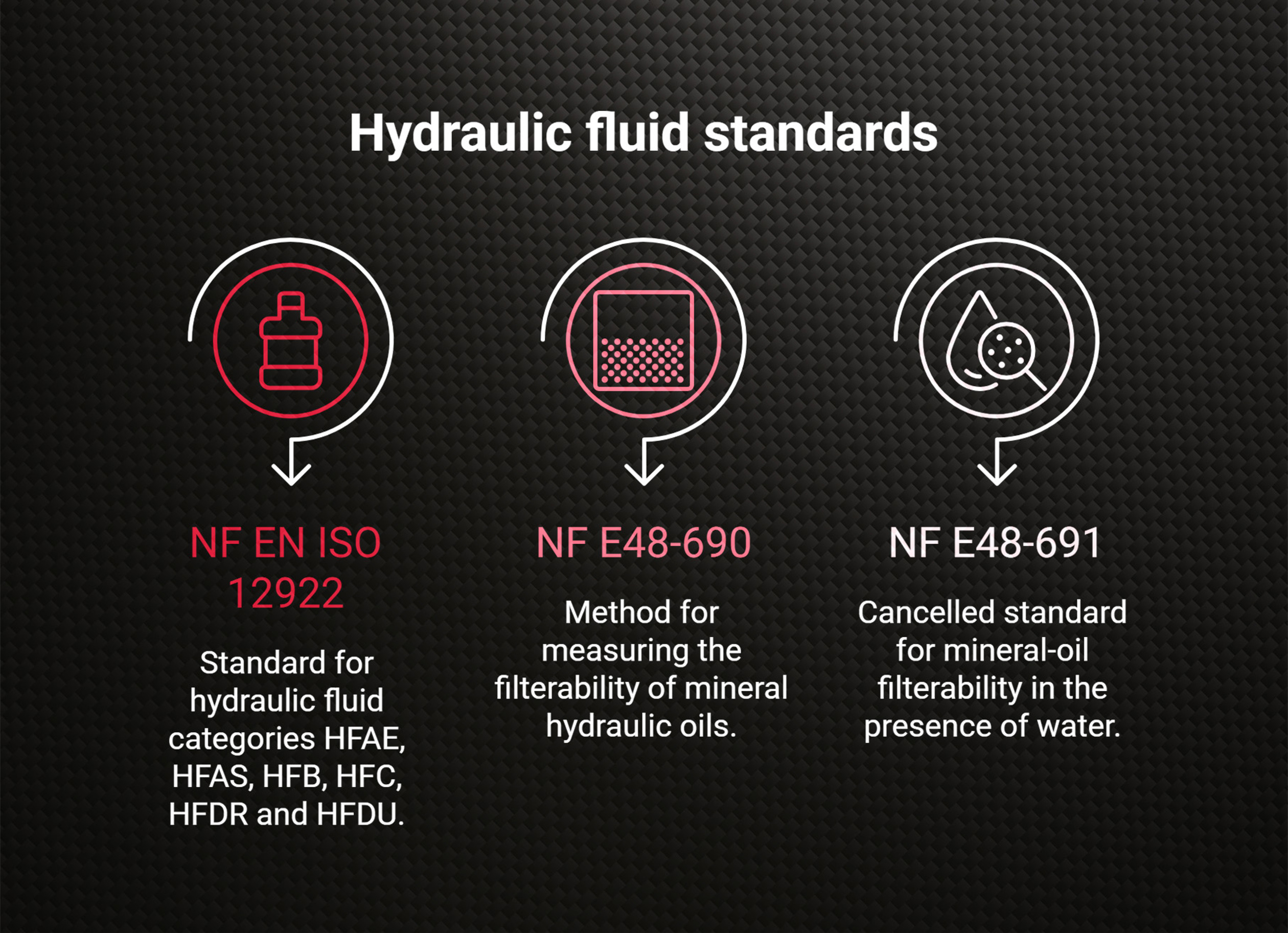
AFNOR’s catalogue lists NF EN ISO 12922, February 2020, for hydraulic fluids in categories HFAE, HFAS, HFB, HFC, HFDR and HFDU.
This document belongs to a different branch of the hydraulic-fluid requirements from NF ISO 11158. Its category references should not be treated as interchangeable with mineral-oil hydraulic-fluid categories. AFNOR identifies the scope and international correspondence of NF EN ISO 12922.
When an equipment manual specifies one of these categories, preserve that requirement in purchasing documents. “Hydraulic oil” alone is not a sufficiently precise description.
Filterability concerns a fluid’s behaviour when passing through a filter under specified conditions. It is one aspect of hydraulic-fluid assessment, rather than a complete performance classification.
NF E48-690
NF E48-690 defines a method for measuring the filterability of mineral hydraulic oils. AFNOR lists its December 1990 edition as current.
The method assesses filter-clogging behaviour while accounting for the influence of viscosity and test temperature. A reference to this method should be accompanied by the relevant result or acceptance requirement. AFNOR describes the purpose of NF E48-690.
NF E48-691 addressed mineral-oil filterability in the presence of water. AFNOR lists the April 1995 edition as cancelled and identifies NF ISO 13357-1 as its replacement.
The distinction between the two tests matters: filterability under one set of conditions should not be assumed to establish performance under another. AFNOR’s NF E48-691 record explains its scope and replacement.
A hydraulic lubricant needs the correct viscosity as well as the required performance characteristics.
For example, ISO VG 46 identifies a viscosity grade under ISO 3448. It does not establish conformity with an AFNOR hydraulic-fluid specification or filterability requirement. ISO 3448 defines the industrial lubricant viscosity classification.
Two products can share a viscosity grade while carrying different performance claims. Similarly, a product range may offer several viscosity grades under one performance category. Check the documentation for the exact grade being supplied.
A reference to an NF standard is not, by itself, evidence of certification.
Keep the following statements separate:
The supplier declares conformity with a standard.
A product has documented third-party certification.
An equipment manufacturer has granted a specific approval.
AFNOR distinguishes standardisation from certification. Consequently, wording such as “meets NF ISO 11158” should not be converted into “AFNOR certified” without supporting certification evidence.
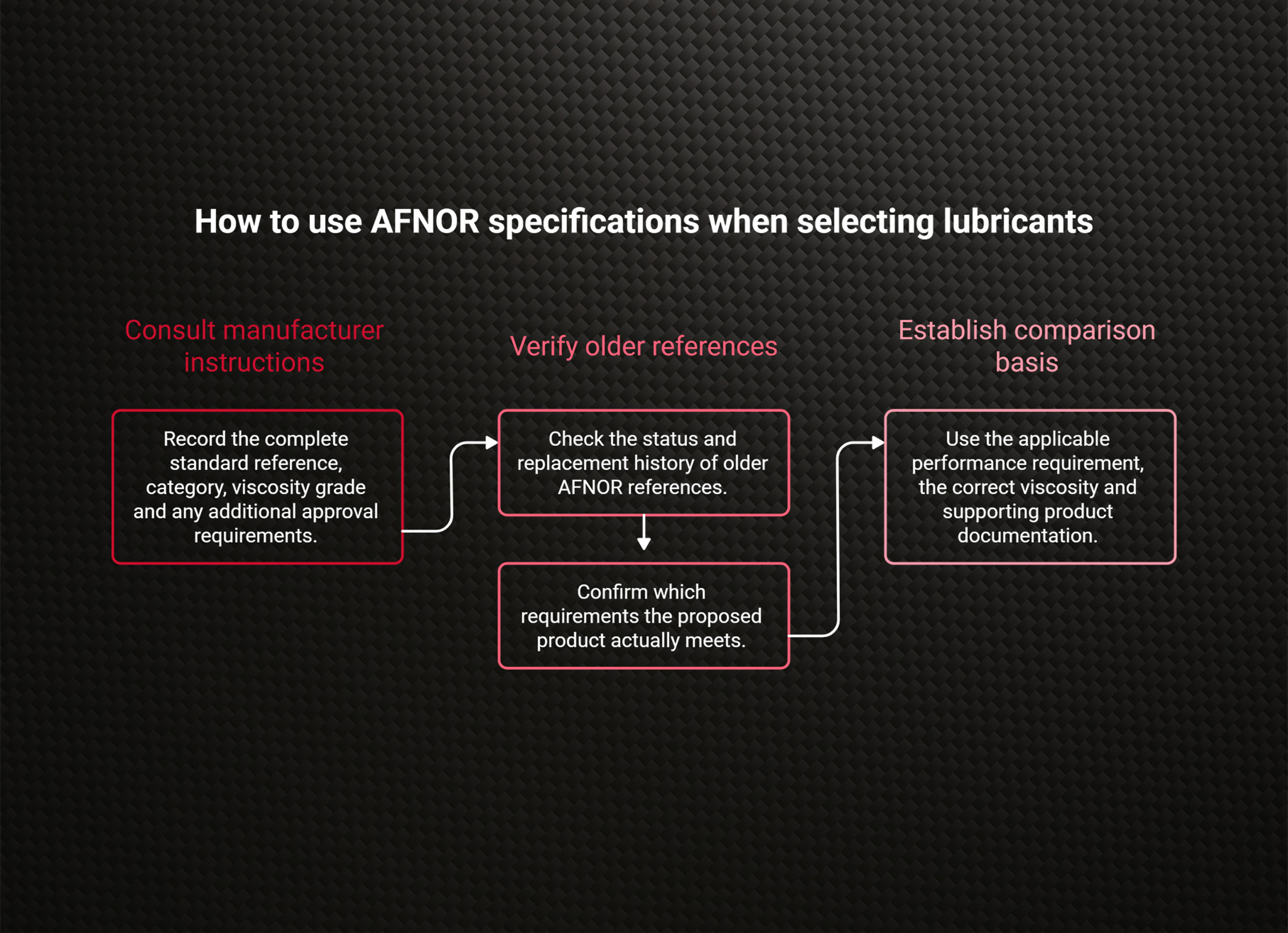
Start with the equipment manufacturer’s instructions. Record the complete standard reference, category, viscosity grade and any additional approval requirements.
Where an older AFNOR reference appears, check its status and replacement history. Then confirm which requirements the proposed product actually meets, rather than assuming that an old and new designation are equivalent.
For distributors and maintenance teams, this creates a clear basis for comparison: the applicable performance requirement, the correct viscosity and supporting product documentation. Each contributes information that the others cannot replace.