
ACEA specifications help automotive professionals identify engine oils with the performance required for particular applications. Understanding these specifications makes it easier to compare products, interpret technical data sheets and avoid unsuitable substitutions.
The essential principle is that a higher ACEA category number does not automatically mean a better oil for a particular engine. Correct selection depends on the vehicle manufacturer’s requirements.
ACEA is the European Automobile Manufacturers’ Association. Its Oil Sequences define minimum performance requirements for service-fill engine oils—the oils used during maintenance.
These requirements provide a common technical foundation, while individual engine manufacturers can demand additional tests or stricter limits. ACEA therefore supports oil selection alongside the original equipment manufacturer’s requirements, commonly called OEM specifications. ACEA’s general requirements explain this relationship.
An SAE viscosity grade, such as 5W-30, describes an oil’s viscosity characteristics. It does not establish its overall engine performance or suitability for an exhaust aftertreatment system. SAE J300 specifically limits its classification to rheological properties.
Consequently, two oils labelled 5W-30 should not be treated as interchangeable simply because their viscosity grades match. The ACEA category and applicable manufacturer requirements also need to match the application.
For distributors and workshops, this distinction matters when organising stock: viscosity alone is an incomplete basis for product selection.
The 2023 light-duty sequences contain A3/B4, A5/B5 and A7/B7, alongside C2 through C7.
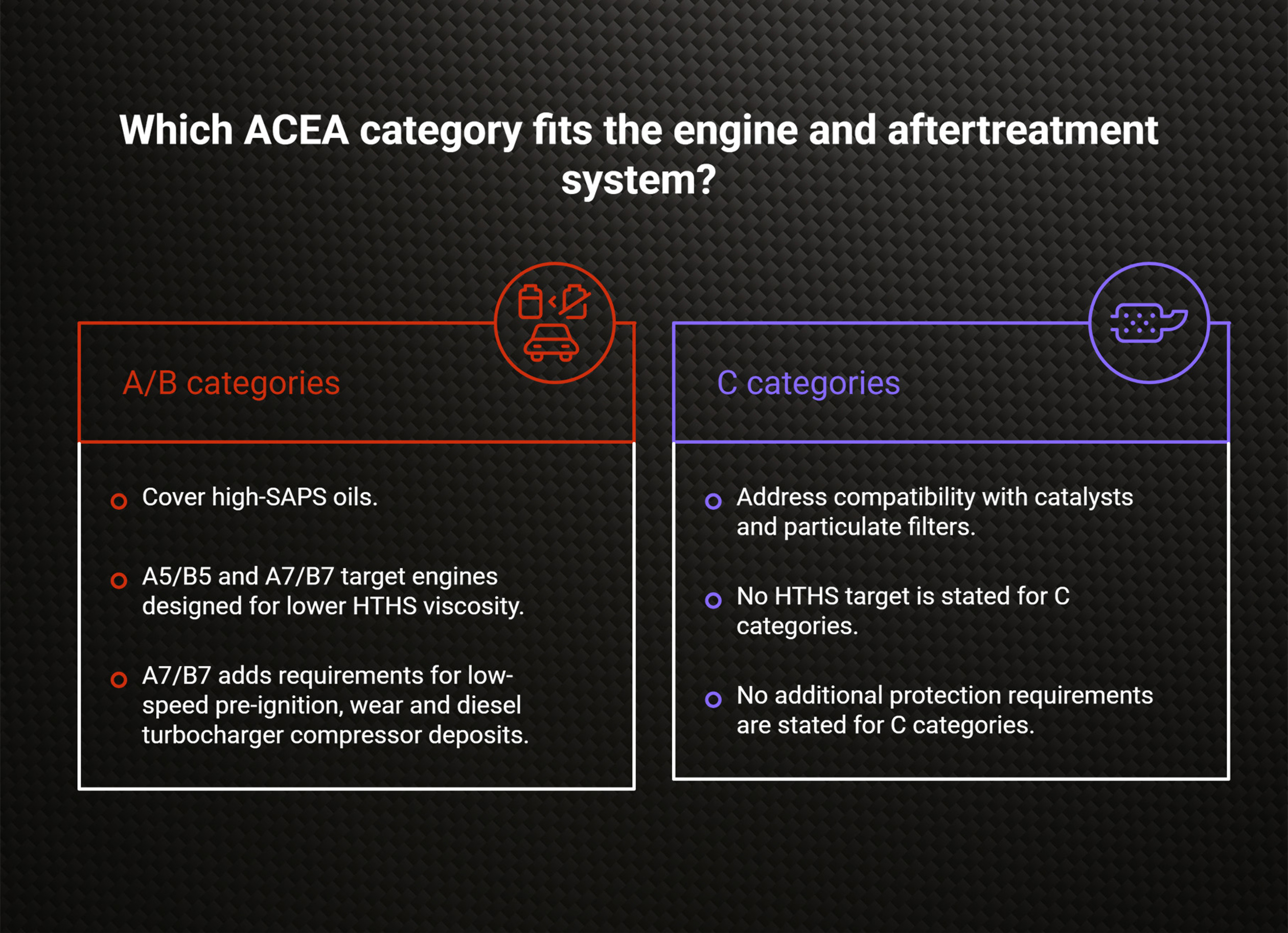
A/B categories cover high-SAPS oils for petrol and light-duty diesel engines. A5/B5 and A7/B7 target engines designed for lower high-temperature, high-shear viscosity. A7/B7 adds protection requirements addressing low-speed pre-ignition, wear and diesel turbocharger compressor deposits.
C categories address compatibility with catalysts and diesel or gasoline particulate filters.
Two terms explain important differences:
SAPS: sulphated ash, phosphorus and sulphur.
HTHS: high-temperature, high-shear viscosity.
Category | Selected distinguishing feature |
|---|---|
C2 | Mid-SAPS; minimum HTHS of 2.9 mPa·s |
C3 | Mid-SAPS; minimum HTHS of 3.5 mPa·s |
C4 | Low-SAPS; minimum HTHS of 3.5 mPa·s |
C5 | Mid-SAPS; fuel-economy focus |
C6 | Adds pre-ignition, wear and turbocharger deposit protection relative to C5 |
C7 | Builds on C6 performance with enhanced fuel economy |
These are selected differences, not complete specifications or substitution rules. The full requirements appear in the ACEA 2023 light-duty sequences.
Engine development increasingly prioritises reduced friction and fuel consumption. ACEA introduced C7 in its 2023 sequences to cover SAE 0W-16 applications, building on the C6 performance framework.
This explains why a newer category may serve a different engine design. The introduction of C7 does not itself authorise changing the oil specification of an existing vehicle. ACEA’s explanation of the 2023 update describes the engineering background.
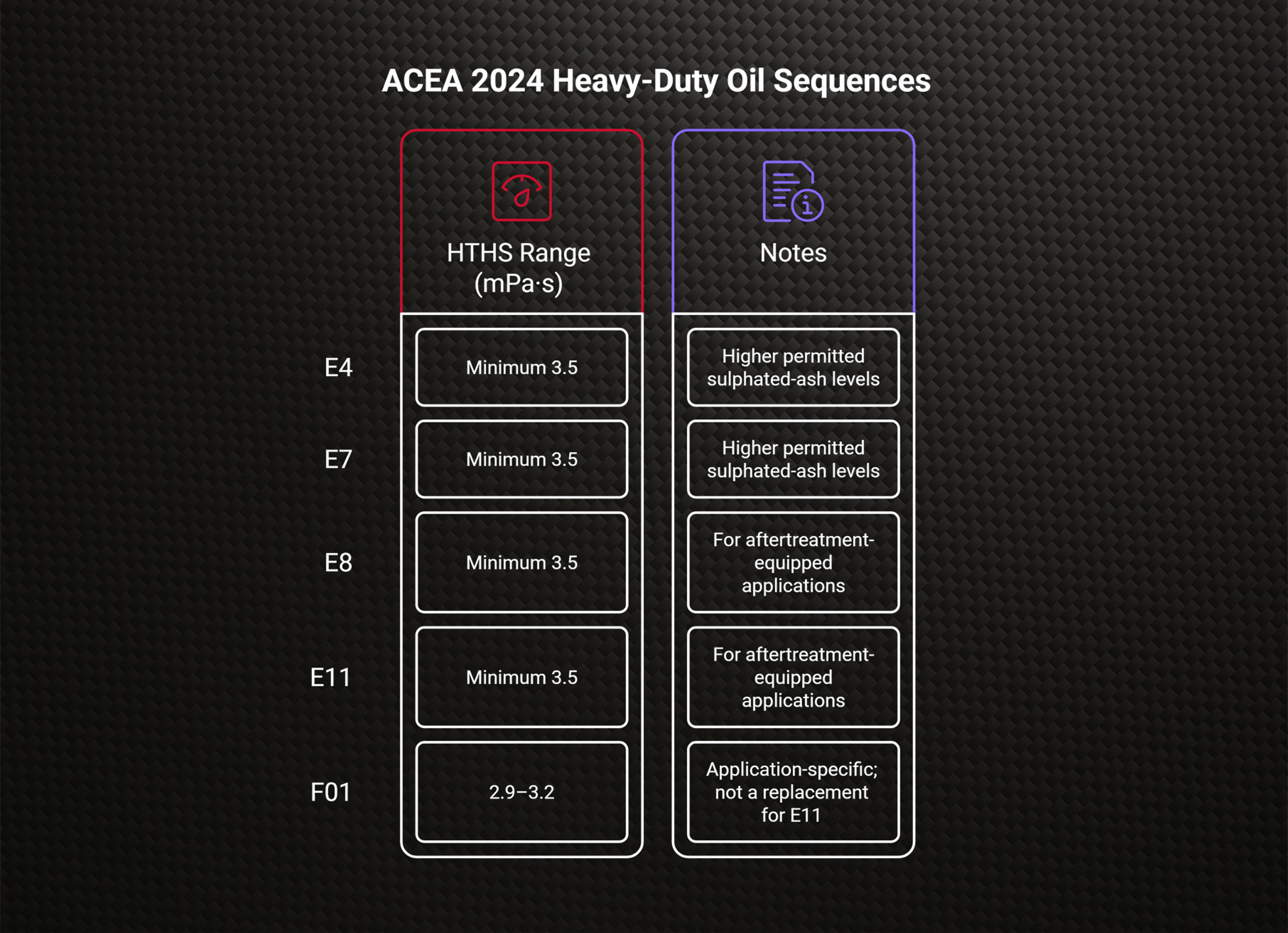
The 2024 heavy-duty sequences, Revision 1, contain E4, E7, E8, E11 and F01.
E4 and E7 have higher permitted sulphated-ash levels than E8 and E11. ACEA’s application guidance identifies E8 and E11 for aftertreatment-equipped applications, subject to manufacturer requirements. Fuel sulphur, biodiesel use and operating conditions also influence suitability.
F01 introduces a distinct viscosity requirement: its HTHS range is 2.9–3.2 mPa·s, compared with a minimum of 3.5 mPa·s for the E categories. This makes F01 an application-specific choice; it should not be assumed to replace E11.
Heavy-duty oil selection must also respect the manufacturer’s drain interval. An ACEA claim alone does not establish how long an oil may remain in service. These distinctions are set out in the ACEA 2024 heavy-duty sequences.
ACEA performance claims operate through self-certification. They must be supported by credible data and controlled testing, following the European Engine Lubricants Quality Management System, or EELQMS.
ACEA also requires compliance with the relevant ATIEL Code of Practice and an oil marketer’s letter of conformance. This is different from an individual OEM approval. A claim that a product meets an ACEA category should therefore not be presented as proof that a vehicle manufacturer has approved it. ACEA’s claim requirements define these responsibilities.
An ACEA category and the edition supporting its claim are separate pieces of information. Specifications evolve, and older editions have limited transition periods.
For example, the 2024 heavy-duty document sets 1 October 2026 as the final marketing date for claims against the 2022 heavy-duty edition. This concerns the edition supporting the claim, rather than automatically withdrawing every category appearing in that edition. ACEA’s validity table provides the relevant dates.
Distributors should therefore request up-to-date product documentation, particularly when reviewing older labels or catalogue entries.
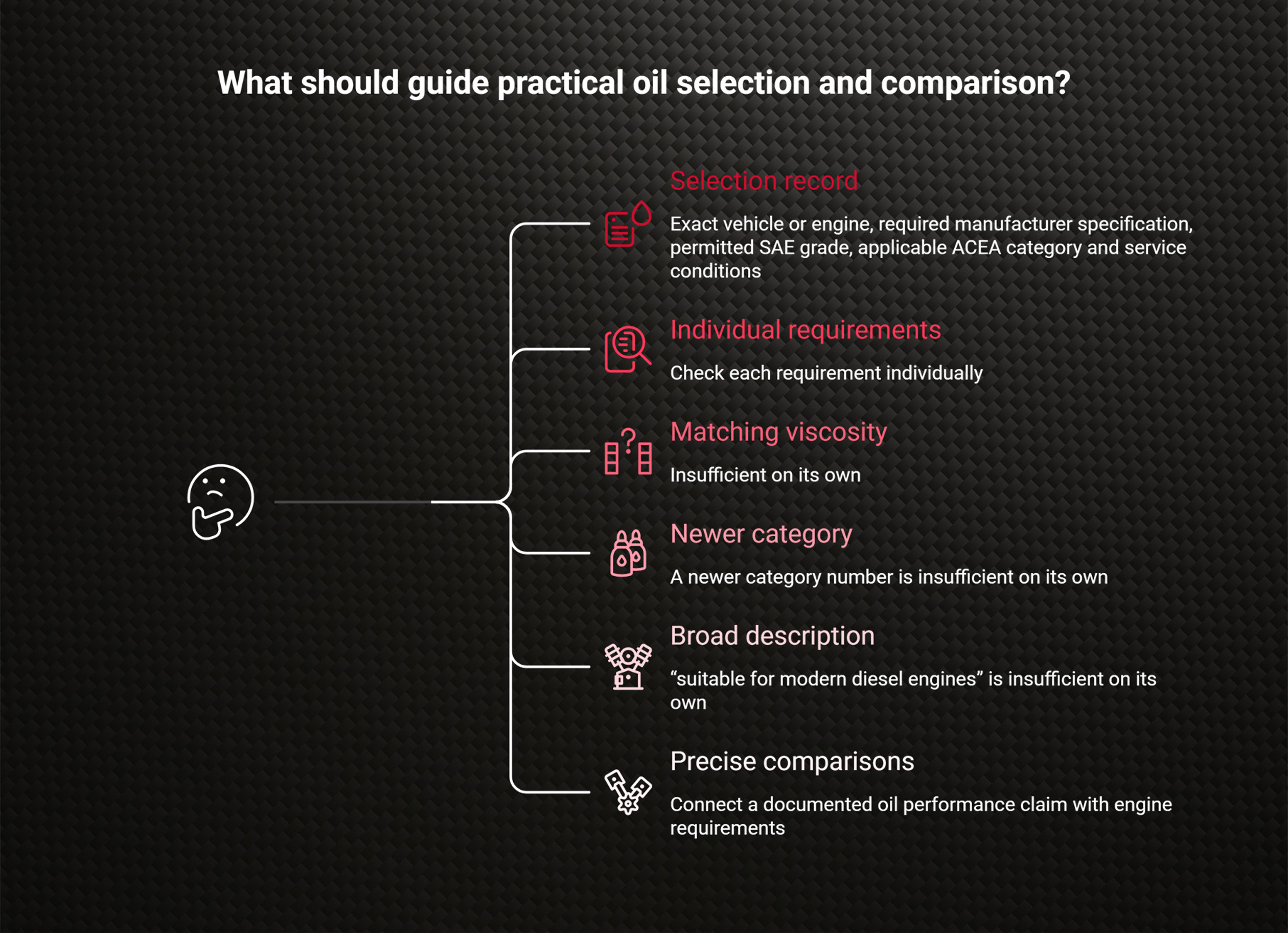
A useful product-selection record brings together the exact vehicle or engine, required manufacturer specification, permitted SAE grade, applicable ACEA category and service conditions.
When comparing alternatives, check each requirement individually. A matching viscosity, a newer category number or a broad description such as “suitable for modern diesel engines” is insufficient on its own.
The practical value of ACEA specifications lies in making those comparisons more precise: they help professionals connect a documented oil performance claim with the requirements of the engine being serviced.